
Qixi 2026: The Consumer Behind China's Valentine's Day Is Changing.
7 Min Read · By YASO
Qixi 2026 felt quieter than in previous years.
There was less of the ubiquitous "I love you" messaging, fewer predictable images of couples embracing, and fewer brands competing with the same red, heart-shaped limited editions.
But this was not a retreat from romance. It was a sign that the consumer behind Qixi is changing. The data points to a broader, more complex occasion:
- National cinema box office reached RMB 288 million on Qixi, but the two romance films released that day accounted for just 2.75% of total box office. (Source: The Paper, citing Lighthouse Data)
- Searches for "Qixi + intangible cultural heritage" increased 110% year on year, while Qixi-related searches on Qunar increased 70% month on month. (Source: Qunar Travel)
- Flower orders among consumers aged 31–45 increased by more than 70%, outpacing younger consumers. Searches for gifts for wives and mothers also continued to rise. (Source: Taobao Flash Shopping data, reported by Sanqin Daily)
- Flower orders on Taobao Flash Shopping increased 30-fold, while cosmetics rose 65% year on year and jewellery 68%. (Source: Taobao Flash Shopping data, reported by Sanqin Daily)
Taken together, the signals suggest that Qixi is moving beyond the simple idea of "Chinese Valentine's Day."
It is worth being precise about what the comparison assumes. Valentine's Day is a courtship festival. Its commercial logic is persuasion: someone is trying to establish or prove a feeling, usually early in a relationship, usually to a romantic partner or someone they hope will become one. The products that sell are the ones that make the case.
That is a specific and quite narrow model. Set it against the Qixi data below, where the buyer is 31 to 45, purchasing for a wife or a mother, and ordering within the hour because they can, and the mismatch is obvious. The label is not wrong about the festival's origins. It is wrong about who is now buying and why.
Romance is still part of the occasion. But it is no longer the whole story. Consumers are using Qixi to express care, celebrate relationships, indulge themselves, discover culture, give useful gifts and create experiences. For brands, the opportunity is not simply to find a better way to market Qixi. It is to understand what Qixi means to Chinese consumers now.
Here are five shifts that stood out in 2026.
1. From romance to broader emotional connection
The "Chinese Valentine's Day" narrative is becoming too narrow
One of the clearest shifts in 2026 was the number of brands moving beyond the conventional romantic narrative and returning to Qixi's cultural origins. The traditional festival is closely associated with Qiqiao, or "begging for skill", when young women historically prayed for craft skills and personal capabilities.
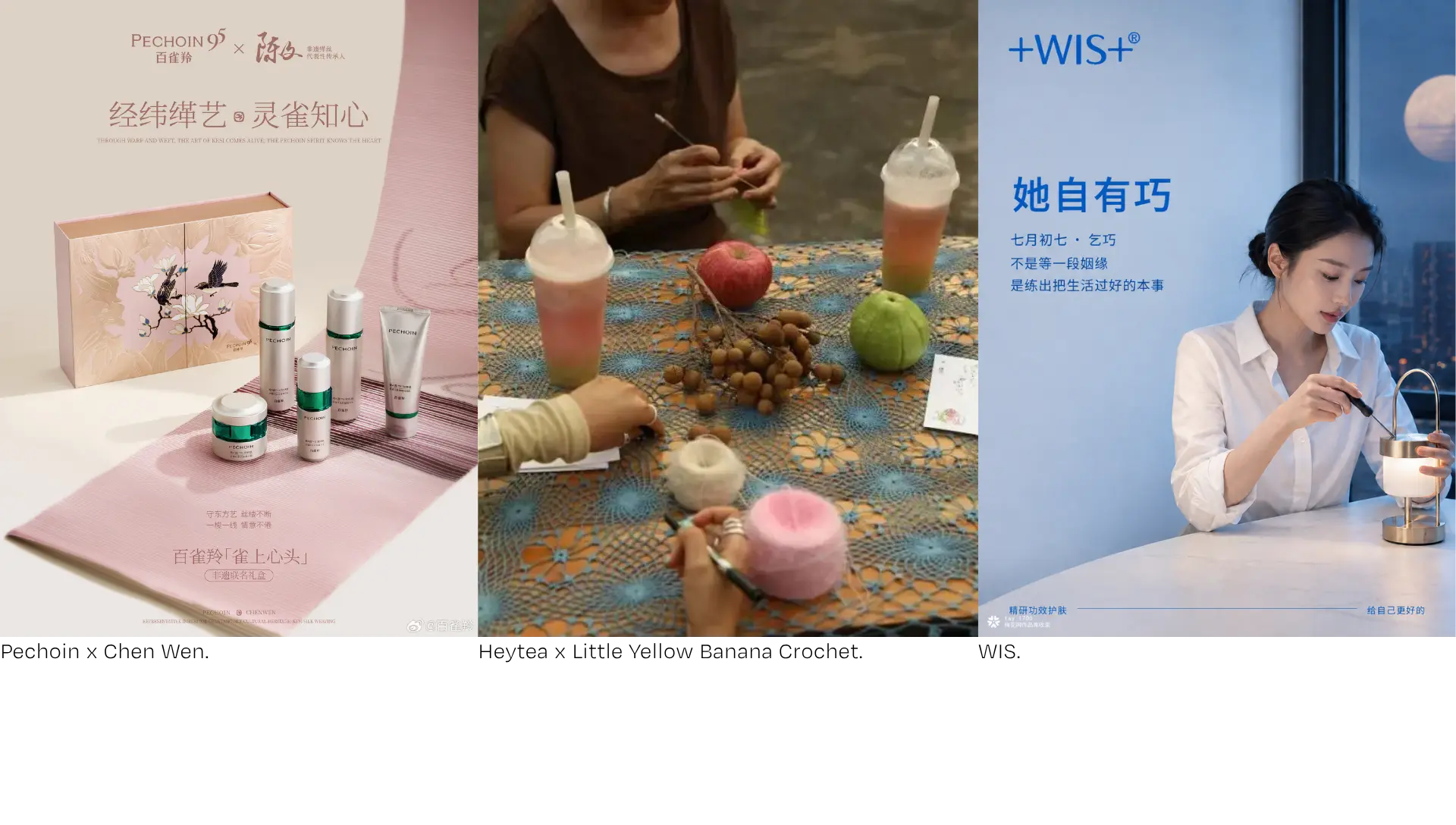
Brands including Pechoin and WIS drew on this heritage to create more distinctive interpretations of the occasion.
Pechoin returned to the traditions of Qiqiao, partnering with intangible cultural heritage kesi silk-weaving artist Chen Wen on its "Que Shang Xin Tou" limited-edition gift set and naming actress Li Sitong its "Ling Si" ambassador. China's intangible cultural heritage system formally recognises individual practitioners of endangered traditional crafts, so naming a designated artist is a specific and verifiable claim rather than a decorative reference. (Source: SocialBeta)
WIS reinterpreted the character "乞" in Qiqiao as "有", opening its campaign with the line: "On the seventh day of the seventh lunar month, what women originally asked for was not love." The campaign positioned fulfilment as something that does not need to be defined or granted by someone else. (Source: Meihua.com)
Heytea partnered with crochet studio "Little Yellow Banana Crochet" to create a guava-themed crocheted phone pouch, handmade by women from Chaozhou's Qiuxi Village, a region in Guangdong known for its textile traditions, and inspired by Qixi's traditional associations with skill and weaving. The item reportedly sold out shortly after stores opened on Qixi. (Source: Shenzhen News Network)
The significance is not that brands are abandoning romance. It is that romance is becoming one expression of a much broader emotional occasion.
The emotional audience is expanding too
This shift is particularly visible in luxury.
Miu Miu centred its Qixi campaign on Chinese actresses Liu Boxin and Zhao Jinmai, surrounded by colourful flowers but without a conventional male-female romance narrative. (Sources: VOGUE Hong Kong; Hypebeast)
ALAÏA featured ballerina Tan Yuanyuan, supermodel Wang Quyou and young director Chen Bige, placing three Chinese women at the centre of the campaign and focusing on movement, vitality and individuality. (Source: VOGUE China)
The common thread is a move from asking "How do I prove that I am loved?" towards "How do I express what this relationship, experience or person means to me?"
That distinction matters because the potential audience for Qixi is much larger than couples. It includes partners, parents, friends and increasingly the self.
2. From "luxury gift" to practical romance
The definition of a special gift is changing
The old equation was straightforward: Qixi limited edition = expensive = special.
That equation is becoming less reliable. More gifting combinations are appearing around RMB 200–300, while consumers are increasingly asking not simply whether something is a Qixi limited edition, but whether it is useful and genuinely suited to the recipient. (Source: The Paper, interview with Yang Zhenghua, founder of Shangqi Advertising)
Douyin Mall's Qixi gifting data reinforces the shift. Technology gifts were led by Lenovo, DJI and ASUS, while beauty, electronics and small appliances also saw strong demand.
A laptop, drone or monitor may not look like a traditional romantic gift. But it makes perfect sense if the underlying question has changed from "What looks romantic?" to "What would make this person happy or be useful to them?"
This is practical romance. The emotional value of a gift no longer depends entirely on how luxurious or conventionally romantic it looks.
Instant retail is becoming part of the emotional experience
The second change is speed. Traditional Qixi gifting rewarded preparation, the more carefully planned the surprise, the more meaningful it appeared. In 2026, instant retail is changing that logic.
Taobao Flash Shopping's Qixi data shows flower orders increasing 30-fold, while cosmetics rose 65% year on year, jewellery 68% and traditional Chinese pastries 51%. Combined orders for flowers with cakes or chocolate increased 74%. (Source: Taobao Flash Shopping data, reported by Sanqin Daily)
New customers accounted for 65–70% of flower orders, with daily new-customer volume more than 25 times the usual level. Consumers aged 31–45 recorded flower-order growth of more than 70%. (Sources: Taobao Flash Shopping data; The Beijing News; Sanqin Daily)
Beauty brands are adapting accordingly. CHANDO, for example, worked with Watsons, Sephora and other retailers across more than 100,000 offline stores, offering delivery of premium gift sets in as little as nine minutes. (Source: Securities Star)
The last mile is therefore becoming more than logistics. Speed itself can carry emotional value. In a market where consumers can act on an impulse immediately, being able to deliver the gift is increasingly part of the gift.
3. From product collaboration to co-created experience
The collaboration is becoming the product
Qixi IP collaborations have moved past the old model of adding an IP to an existing product and changing the packaging.
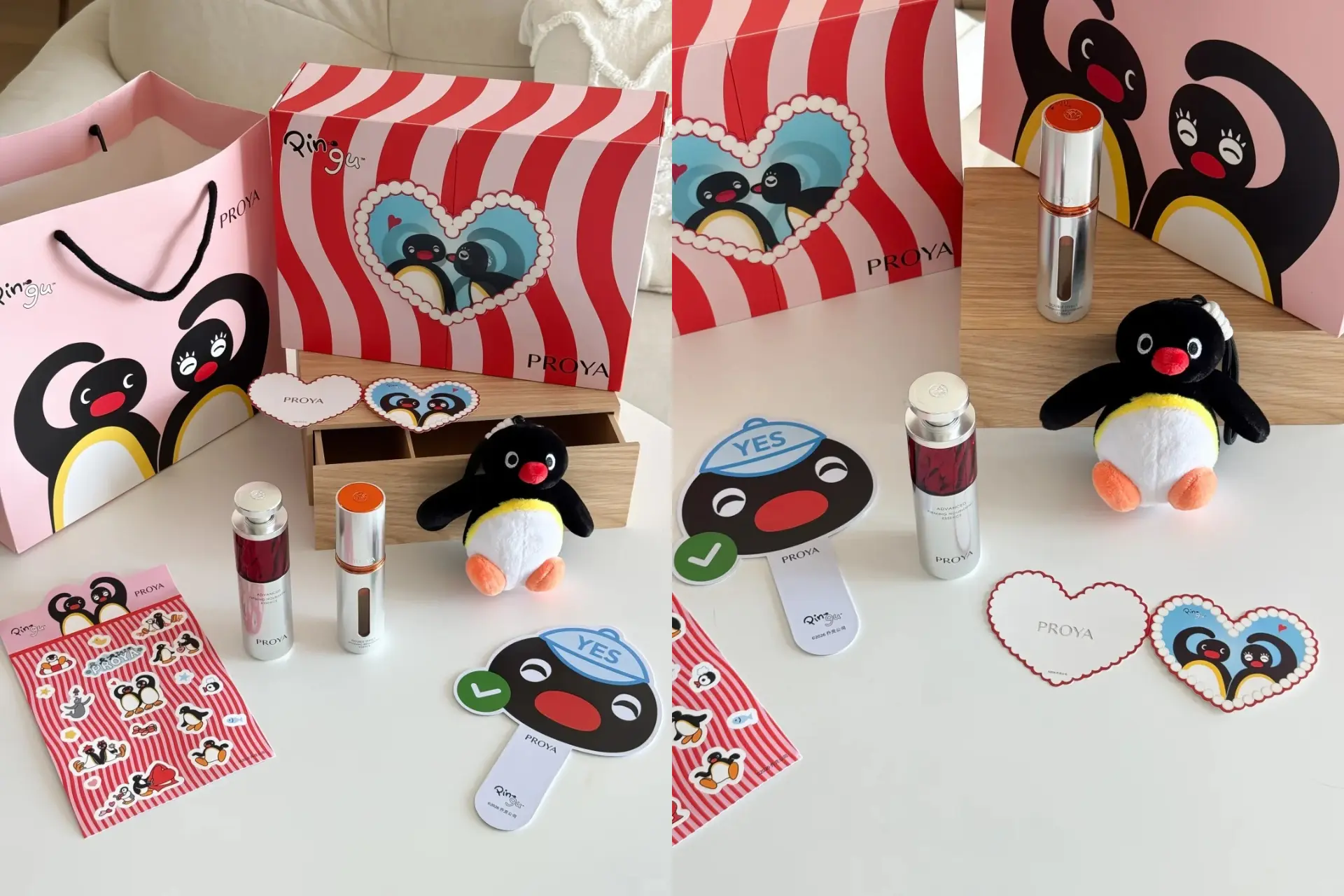
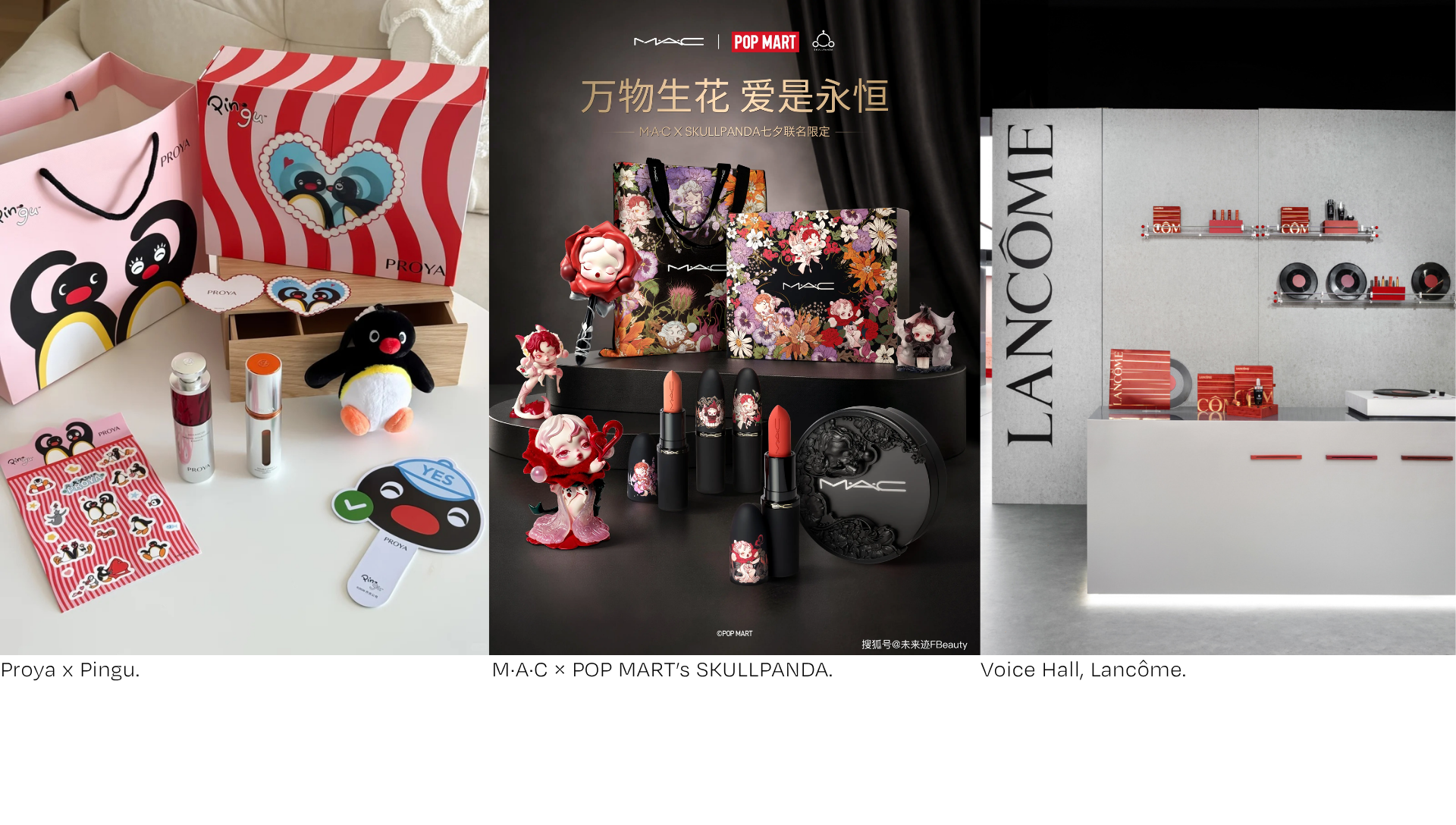
Proya × Pingu's Qixi gift set used a lenticular card to make Pingu and Pinggi, the Swiss stop-motion penguin characters, appear to interact, with an "interactive love letter" mechanism inside the box. (Source: SocialBeta)
The packaging itself became the content, designed to be opened, filmed and shared, not just a way to borrow relevance from an IP.
SK-II partnered with POP MART's collective figure brand CRYBABY on a limited-edition gift set, connecting its established world of authentic emotions and self-care with a popular Chinese IP. The collaboration extended across the product line and into a temporary pop-up at Shanghai's North Bund, rather than stopping at artwork on a box. (Source: SocialBeta)
Offline is becoming part of the campaign again
As digital attention gets harder to capture, brands are rediscovering physical experience.
Lancôme's "Voice Hall" pop-ups ran simultaneously in Shenzhen, Shanghai and Zhengzhou, using vinyl records to connect lipstick with music. (Source: SocialBeta)
These spaces give consumers something to enter, interact with and remember, another form of emotional expression, not just awareness.
4. From formulaic romance to more nuanced storytelling
Luxury turned the volume down
The shift is equally visible in content. Luxury brands showed considerable restraint in their Qixi storytelling this year.
Prada released Love in the Same Sequence, placing two groups of people in parallel worlds who never actually meet but remain aware of each other. The story moves away from the conventional "magpie bridge reunion" narrative. (Source: Jiemian News)
Saint Laurent launched Letters Short, Love Long, using private correspondence as the starting point. (Sources: BrandStar; SocialBeta)
LOEWE worked with brand ambassador Jiang Qiming on three silent short films with no dialogue or narration, allowing emotion to emerge through expressions and pauses. (Source: SocialBeta)
The common thread is striking: they do not say "I love you" directly. Instead, brands are exploring ambiguity, intimacy, individuality and emotional complexity.
This is not necessarily less romantic. It is a more contemporary understanding of what romance can look like.
5. From a festival calendar to a consumer moment
Perhaps the biggest shift is not in the creative at all. It is in the way brands need to think about the occasion itself.
The Qixi consumer is changing
The data suggests that Qixi is becoming:
- Older — with 31–45-year-old consumers increasingly active in gifting
- Broader — with gifting extending beyond romantic partners to wives, mothers and other important relationships
- More practical — with useful products competing successfully with traditional luxury gifts
- More immediate — as instant retail changes when and how consumers express care
- More experiential — with packaging, pop-ups and physical spaces becoming part of the value exchange
- More culturally curious — with rising interest in intangible cultural heritage and the traditional meaning of Qixi
This makes the label "Chinese Valentine's Day" increasingly inadequate. It describes the romantic origin point of the commercial occasion, but not the full range of behaviours happening around it today.
What this means for global brands
The lesson is not to drop romance, or to rebuild every Qixi campaign around traditional culture. It is: don't market the occasion before understanding the consumer within it.
A global understanding of Valentine's Day, gifting and romance can become a limiting assumption when the Chinese consumer behind it is evolving.
The opportunity is to ask different questions:
- Who is buying? Increasingly spouses, parents, friends and individuals buying for themselves, not just couples.
- What makes the gift meaningful? Usefulness, relevance and emotional fit, not necessarily price or exclusivity.
- When does the moment happen? Increasingly the next hour, not days in advance.
- What does the consumer want to do with the brand? Open, interact, photograph, share and participate, not simply watch.
And most importantly: who inside the organisation is close enough to see these changes, and empowered to act on them?
That is where proximity matters. The brands that respond best to China's changing occasions are not the ones with the biggest budgets, but the ones able to turn local signals into decisions.
Conclusion: Qixi is not losing its romance. The consumer is redefining it.
Qixi 2026 does not suggest that Chinese consumers have stopped caring about romance. It suggests that romance itself is becoming broader.
It can mean giving a partner something useful. Buying flowers for a mother. Celebrating a friendship. Buying something for yourself. Discovering a traditional craft. Opening a gift that is designed to be played with. Or simply acting on the feeling the moment it occurs.
For brands, the opportunity is therefore not to create a better "Chinese Valentine's Day" campaign. It is to understand the people who have made Qixi into something bigger.
The occasion is changing because the consumer is changing. And for brands operating in China, staying close enough to see that change may matter more than having the perfect global occasion template.
How YASO can help
The shift behind Qixi 2026 is the same shift behind most of the moments that matter in China: the signal arrives locally, and it moves fast. By the time a change like this shows up in a global trend report, the window to act on it has often already narrowed.
This is what proximity is for. YASO operates inside the Chinese market, not alongside it, which means we see these shifts as they form: in search behaviour, in platform data, in what is actually converting versus what only looks like it is. We turn that into decisions our brand partners can act on, whether that means adjusting a campaign brief, rethinking a gifting price point, or knowing which cultural reference will land and which will not.
Author: Murphy Chen, Snr Growth Marketing Manager and China Content Specialist
Enquiries: Effie Chen, Senior Business Development Lead