
You're Already on RedNote. Why Isn't That Enough for China's AI Search?
6 Min Read · By the YASO GEO team

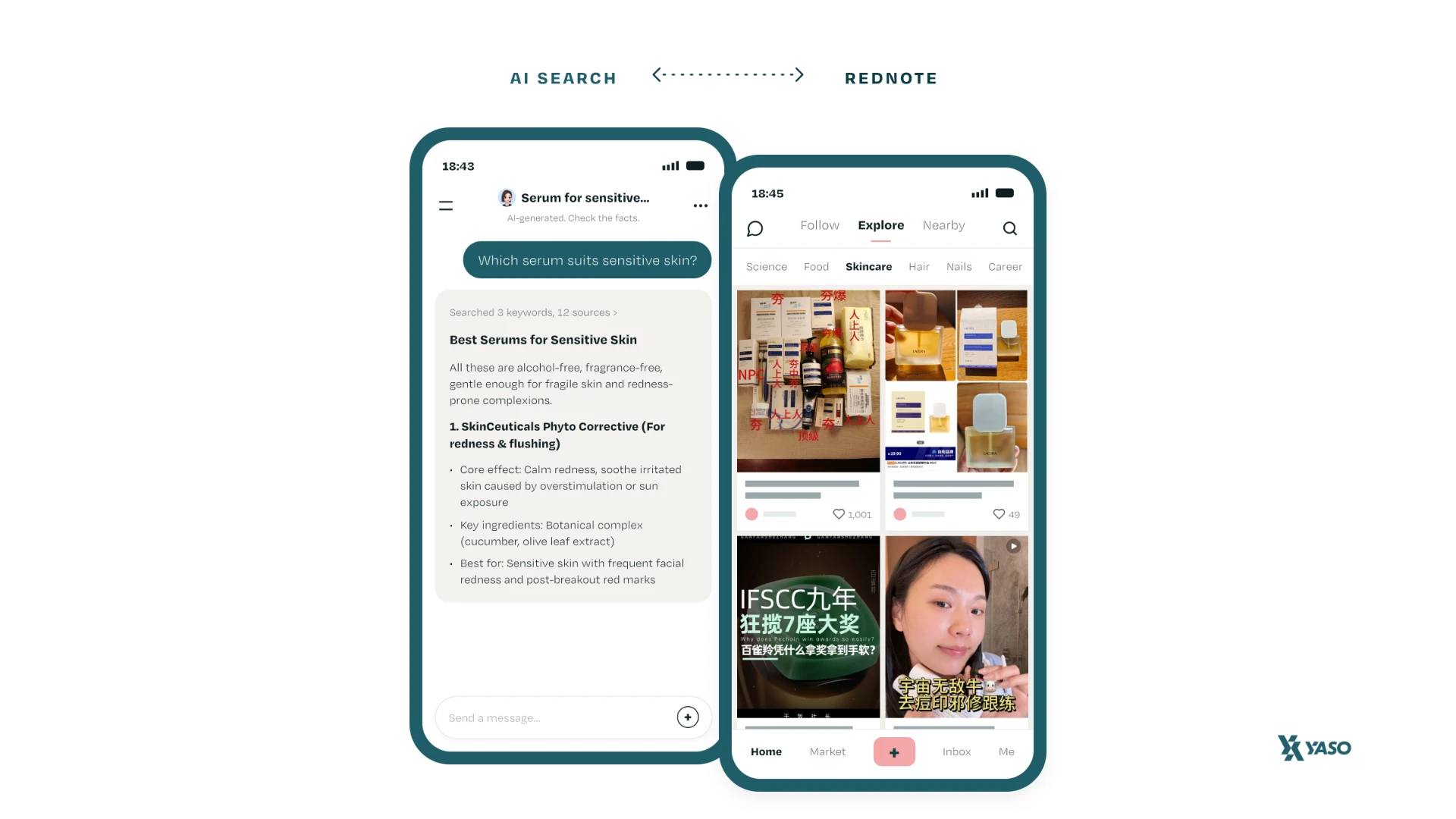
RedNote and AI search do different jobs in a shopper's journey. Brands in China need both.
This is the first article in YASO's China GEO series. Over the series, we'll cover why China's AI search matters, how it judges brands, how brands can optimise for it, and how to measure results.
"We already spent a lot on RedNote. Why do we need China GEO too?"
It's the question we hear most in demos. The short answer: GEO doesn't replace RedNote. It adds to your marketing, alongside your existing social and search activity.
In Western markets, you wouldn't put your whole budget into Instagram and nothing into Google, or the other way round. Each does a different job. China is the same: RedNote and AI search sit at different points in how consumers decide what to buy.
Different tools for different jobs
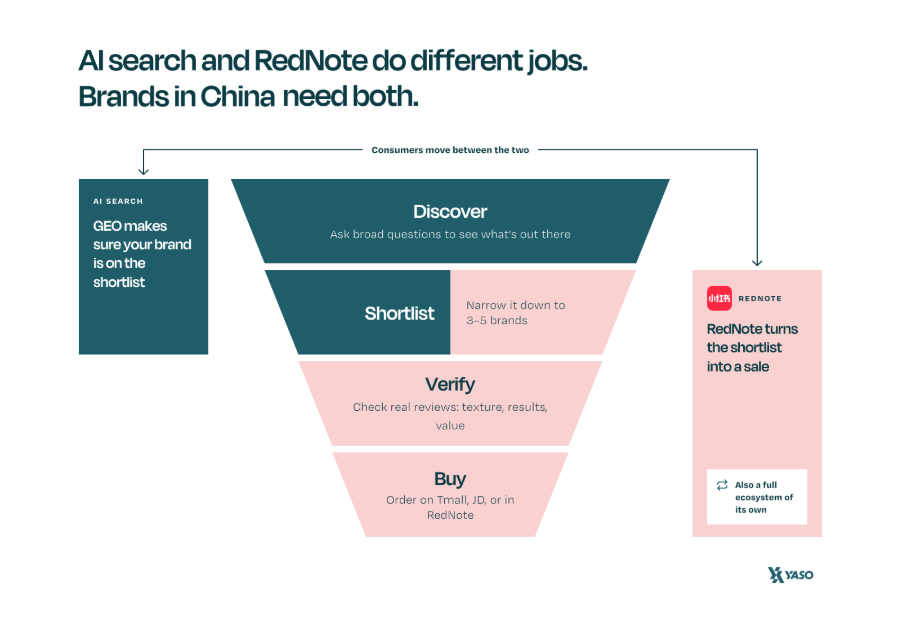
- AI search works at the top and middle of the funnel. Consumers ask broad questions, such as "which serums suit sensitive skin?", and AI replies with a short list of brands to consider. GEO makes sure your brand is on that list.
- RedNote works at the middle and bottom of the funnel. Consumers don't blindly trust AI. Once they have a shortlist, many go to RedNote to see what real people say about texture, results and value, and then buy.
- Consumers move between the two.
There is no doubt of RedNote's importance within the funnel. RedNote is an ecosystem in its own right, where many people discover, compare and buy without leaving the app. Its scale is huge: according to RedNote's 2025 Top 10 Search Trends Report, as cited by Huxiu in February 2026, 73% of monthly active users search on the platform and users searched 250 billion times in 2025. RedNote's own 2024 Search Advertising White Paper found that nine in ten users say search results there influence what they buy. The new entry route to the consumer funnel provided by AI search is where we're already seeing customer behaviour change.
AI is a new front door
That top-of-funnel role is growing fast. China had more than 700 million generative AI users by mid-2026, over half the population, and 76% use it to answer questions (CNNIC, Report on the Development of Generative AI Applications, 2026).
AI is also moving into purchase decisions. According to The State of Fashion: Beauty by McKinsey and The Business of Fashion (June 2025), 53% of Chinese consumers are willing and confident to take AI's advice when choosing beauty products, the highest of any market surveyed.
If your brand isn't in AI's answer, you may never make the shortlist, and consumers won't go looking for you on RedNote, your website or an e-commerce platform.
Why RedNote success doesn't carry over into AI
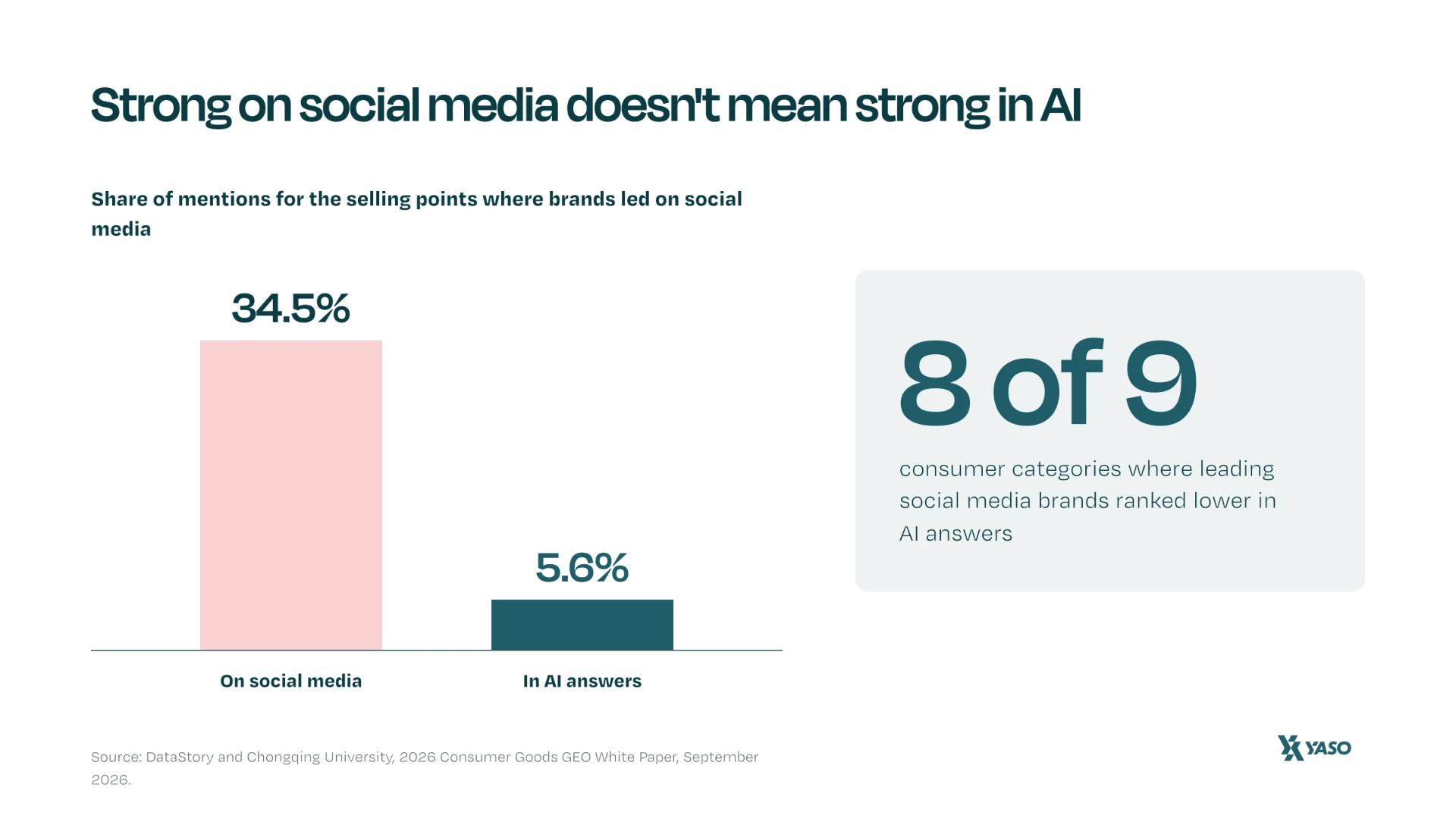
Many brands assume that if they're strong on RedNote, AI will pick that up. The data says otherwise. DataStory and Chongqing University's 2026 Consumer Goods GEO White Paper (September 2026) compared brands' social media data with how they appear in AI answers, across nine consumer categories and six AI platforms. In eight of the nine categories, the leading brands on social media ranked noticeably lower in AI answers. The selling points where brands led on social media fell from a 34.5% share of mentions to just 5.6% once inside AI. Swisse, for example, ranked #3 for vitamins and minerals on social media, but #22 in AI answers.
There are two reasons.
First, AI can't yet see most of what happens on RedNote. RedNote's public web version is intentionally limited to prevent scraping by search engines, and this applies to AI models too. The notes, comments and discussions that build your reputation on RedNote are largely out of reach for Doubao, DeepSeek, Kimi, Yuanbao and Qwen.
The data backs this up. NewRank tracks which sources AI platforms cite for beauty and personal care questions every month. In both August and September 2026, RedNote did not appear in the top ten most-cited sources on any of the six major AI platforms it tracks. RedNote content can still reach AI indirectly, through other websites, media coverage or third-party content, but what you build there doesn't automatically turn into AI visibility.
Second, AI looks for evidence, not the way brands talk on social media. The DataStory research found that brands tend to talk about experience, identity and occasions, while AI relies on objective evidence: specifications, ingredients, test results and terms. A selling point that's widely discussed on social media still needs credible, citable sources to prove it before AI will use it.
Where do China's five main AI platforms get their information?
If AI isn't reading RedNote, what is it reading? Each platform picks its sources differently. NewRank's GEO Industry Source Data: Official Citation Guide for 10 Industries × Major AI Platforms (September 2026) analysed real questions and citations from August 2026 across six platforms and ten industries. Here's what it found for the five YASO focuses on.
- Doubao favours ByteDance content. Douyin and Toutiao feature heavily, as does content that helps people decide what to buy. For beauty brands, that means paying attention to how reviews, user experiences and buying guides appear on the right channels.
- DeepSeek favours encyclopaedias, expert content and niche sites. Baidu Baike ranks highly across several industries, and SMZDM (a product review and deals site) is a key source for shopping questions. Company and niche websites can be cited too. Content needs to be expert, complete, credible and answer the question directly.
- Kimi favours news portals and in-depth content. Sohu ranks highly across several industries, and WeChat Official Accounts are also prominent. Clear, thorough content that answers questions in depth belongs in your GEO plan.
- Yuanbao favours WeChat and the Tencent ecosystem. WeChat Official Accounts were its top source in all ten industries, followed by Tencent News and Penguin Account. Check that your brand information on WeChat is complete and accurate.
- Qwen favours authoritative media, with a wide spread of sources. It cites many different sources across industries, with established news media prominent in several. Choose the specialist media and authoritative sources that fit your category, rather than relying on one channel.
In beauty and personal care specifically, these were the top three cited sources on the five platforms YASO tracks:
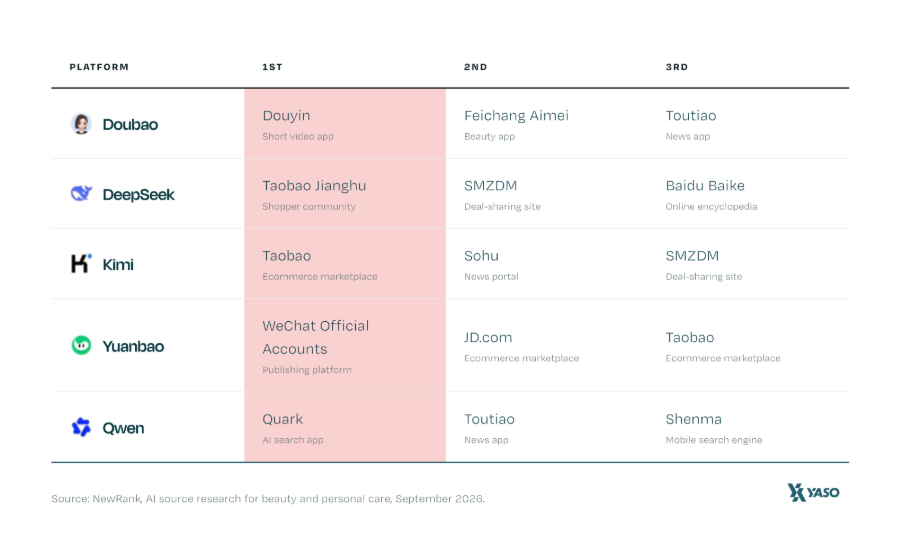
These rankings move from month to month. Between August and September, JD.com rose to second place on Yuanbao, SMZDM entered Kimi's top three, and a dedicated beauty app appeared in Doubao's top three for the first time. So not every answer will follow the same pattern. But the point stands: each platform has its own preferences, they keep shifting, and one content strategy won't cover them all.
Three risks of relying on RedNote alone
1. You don't make AI's shortlist
If AI can't reach your RedNote content and other sources are thin, you may not make the answer, however many notes you have.
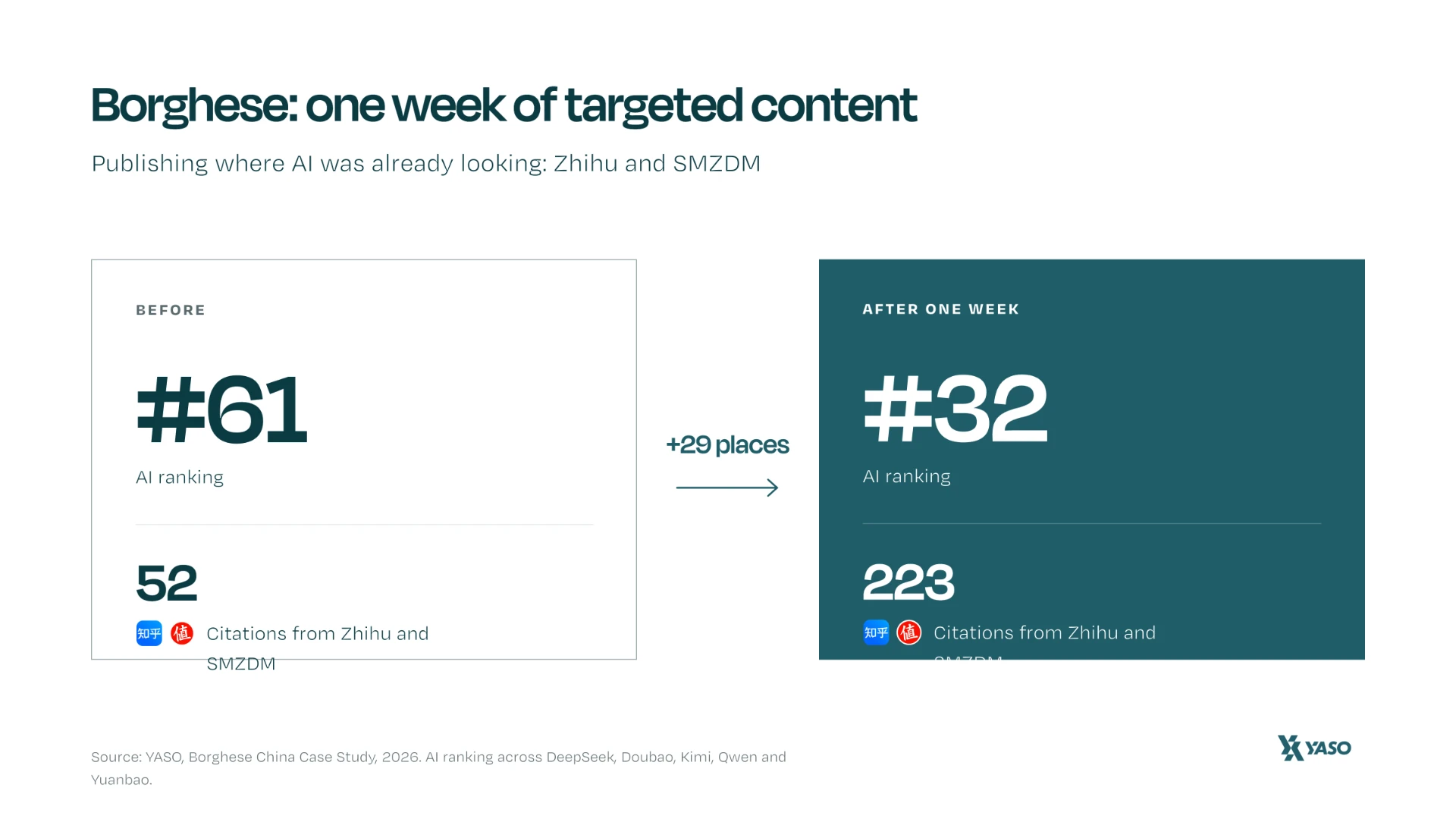
Take Borghese. In 2026, YASO rebuilt its RedNote presence, and its Tmall sales grew 154% during 618. Yet in AI answers, it ranked only #61. Three of the assistants, DeepSeek, Qwen and Yuanbao, were drawing on Zhihu and SMZDM, where competitors were cited six to nine times as often. After a week of targeted content on those two platforms, Borghese climbed to #32. Read the full Borghese case study.
2. Competitors show up more often
When consumers ask for recommendations, AI tends to cite sources with clear product information, expert explanations or direct comparisons. If competitors have fuller information in those sources, AI will find it easier to describe and recommend them.
You won't see this gap in your social media metrics. RedNote notes, engagement and creator reach show how you perform on RedNote, not how visible you are on the five AI platforms. Without monitoring AI answers, you can't tell whether you're on the shortlist, or where competitors are ahead.
3. AI gets your brand wrong
If product descriptions conflict across sources, or official information is thin, AI may get your ingredients, skin types, benefits, price or positioning wrong. For beauty and wellness brands, that can hurt both reputation and compliance.
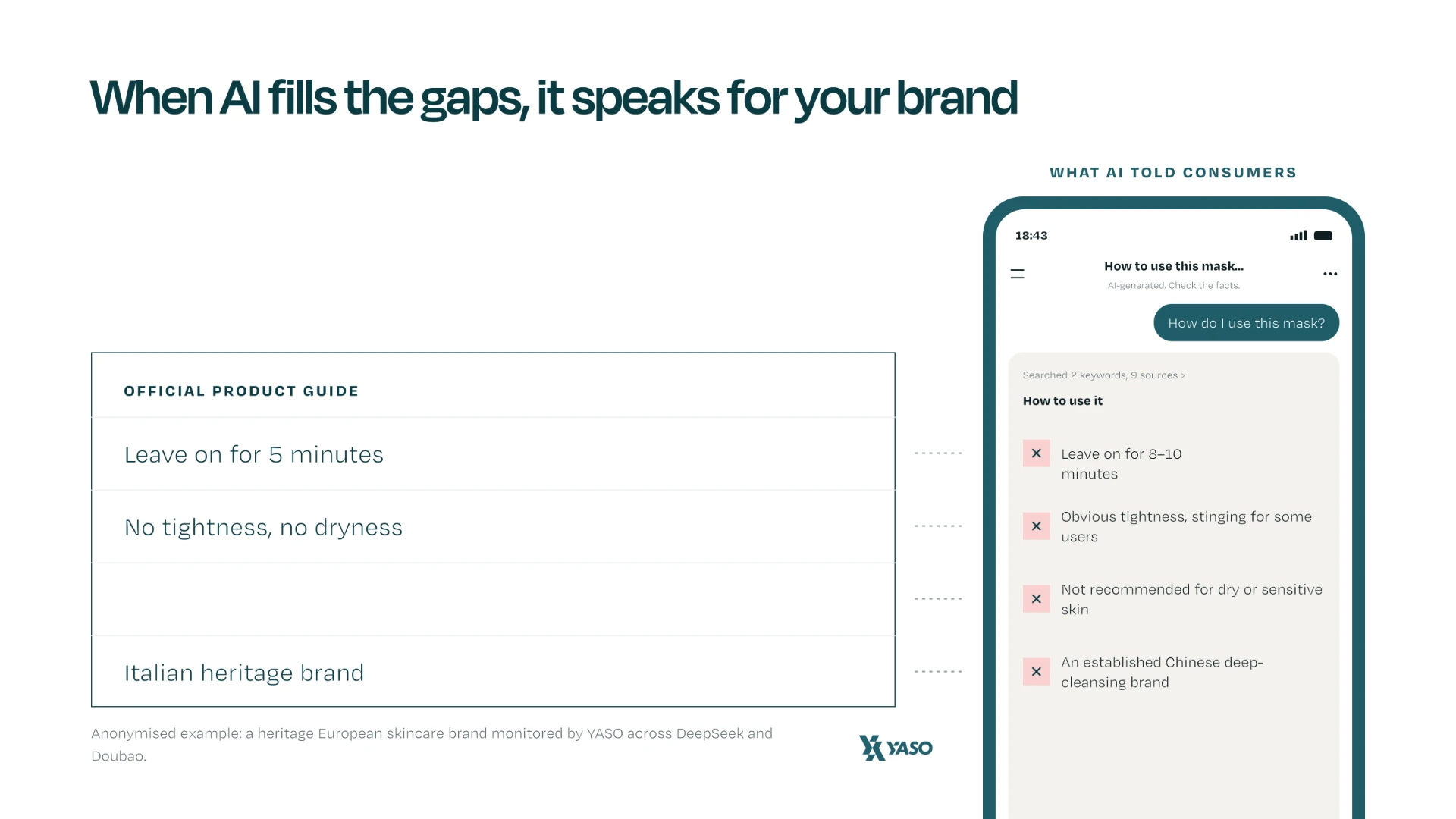
Take Borghese as an example. Its official product guide says to leave its hero mud mask on for five minutes, with "no tightness, no dryness". Yet DeepSeek and Doubao tell consumers to leave it on for 8–10 minutes, then warn of "obvious tightness", "stinging for some users" and that it's "not recommended for dry or sensitive skin". AI got the instructions wrong, and that error turned into negative sentiment about the product itself. DeepSeek even called this Italian-born brand "an established Chinese deep-cleansing brand".
When a brand's own facts aren't in the sources AI draws on, AI fills the gaps itself, and speaks for the brand. So make sure key product information is accurate, consistent and easy to understand on your website and other accessible sources.
Where to start
Don't rush to publish content everywhere. First, find out how AI sees your brand today.
Ask Doubao, DeepSeek, Kimi, Yuanbao and Qwen the questions your customers actually ask. Then look at four things: whether AI mentions you, whether it actually recommends you, which sources it cites, and where you rank against competitors.
Many brands discover the most hidden gap of all: they're mentioned, but not recommended. That's the subject of the next article in this series.
For brands building a long-term business in China, the goal is to be found and accurately represented wherever consumers look: in AI answers when they're building a shortlist, and on RedNote when they're deciding what to buy.
Next: Mentioned isn't recommended. How China's AI judges your brand
In the next article, we'll look at the difference between being mentioned and being recommended, and how to see where your brand really sits in AI answers.