
What is Kuaishou, and why should global beauty brands care?
8 Min Read · By YASO
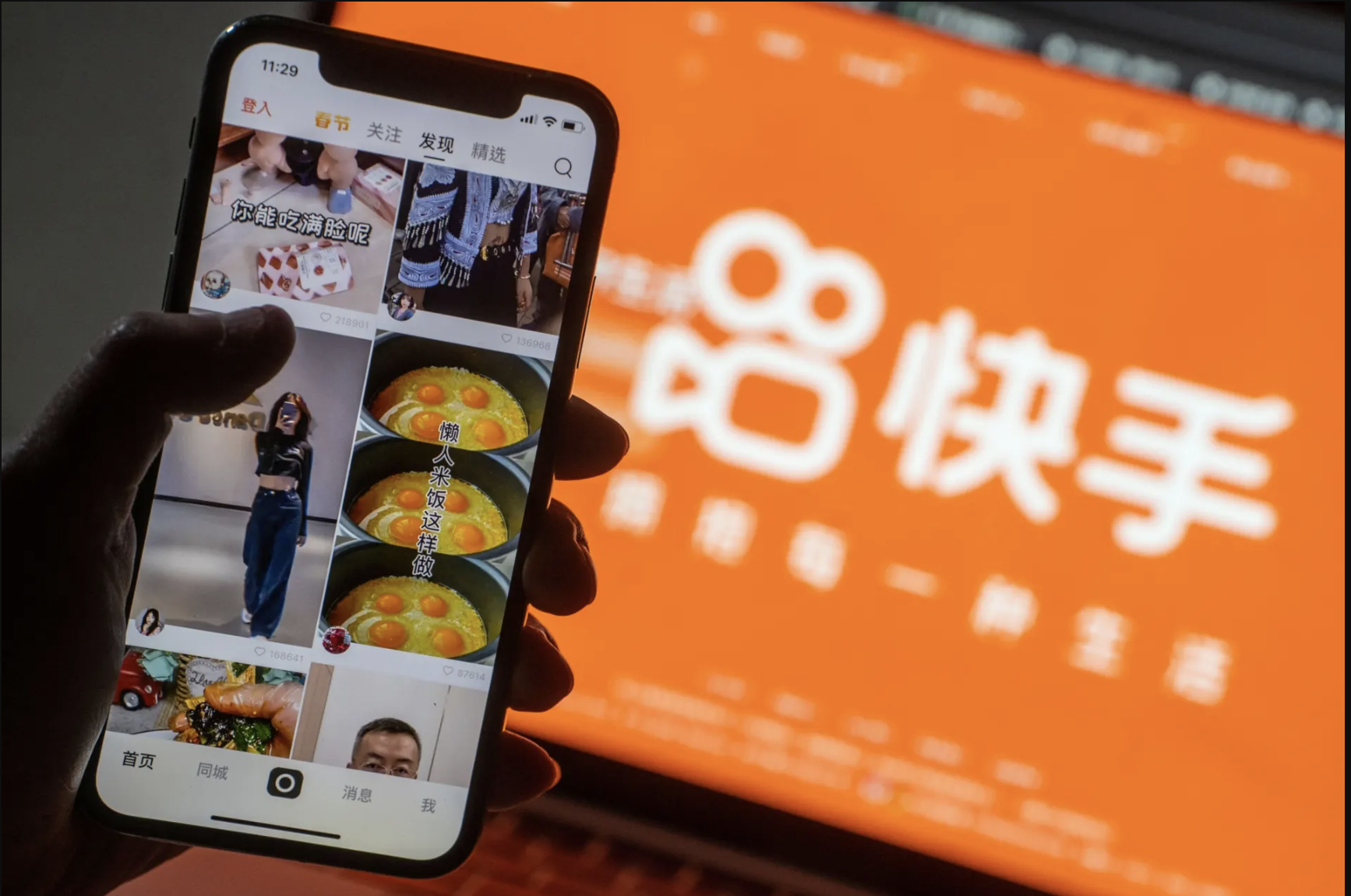 Image credit: Roy Liu, Bloomberg
If you are evaluating the China market, you have probably heard of Tmall, Douyin and RedNote, and possibly WeChat. Kuaishou is the one most global brands overlook, which is precisely why it is worth eight minutes of your time.
Four things to take away
1. The market deserves a fresh look, and content is now the battleground.
China's cosmetics market reached RMB 1.104 trillion in 2025 (roughly USD 155 billion), growing faster than overall consumer retail, but domestic brands now hold 57.4% of it. Short video accounts for more than half of online beauty sales, and close to seven in ten beauty brands are increasing their short-video spend. A brand that is weak on content is weak in China.
2. Kuaishou is not a copy of Douyin. It is the other half of the population.
More than 200 million Kuaishou users do not use Douyin, and more than 500 million do not use RedNote. Beauty buyers active only on Kuaishou skew higher in spending power than its beauty audience overall.
3. The biggest supply gap sits at RMB 50 to 500, which is where you sit.
The low-price band is oversupplied. The mid band is where demand outruns supply. This overturns the assumption that Kuaishou only sells cheap products.
4. Its asset is trust, and in beauty trust means repeat purchase.
Kuaishou's top 100 brands see repeat-purchase rates close to twice the platform average, and a loyal repeat customer is worth 5.5 times a one-time buyer.
First, the platform landscape
China has no single dominant shopping app in the way the West relies on Amazon. Different platforms do different jobs, and the same consumer moves between them.
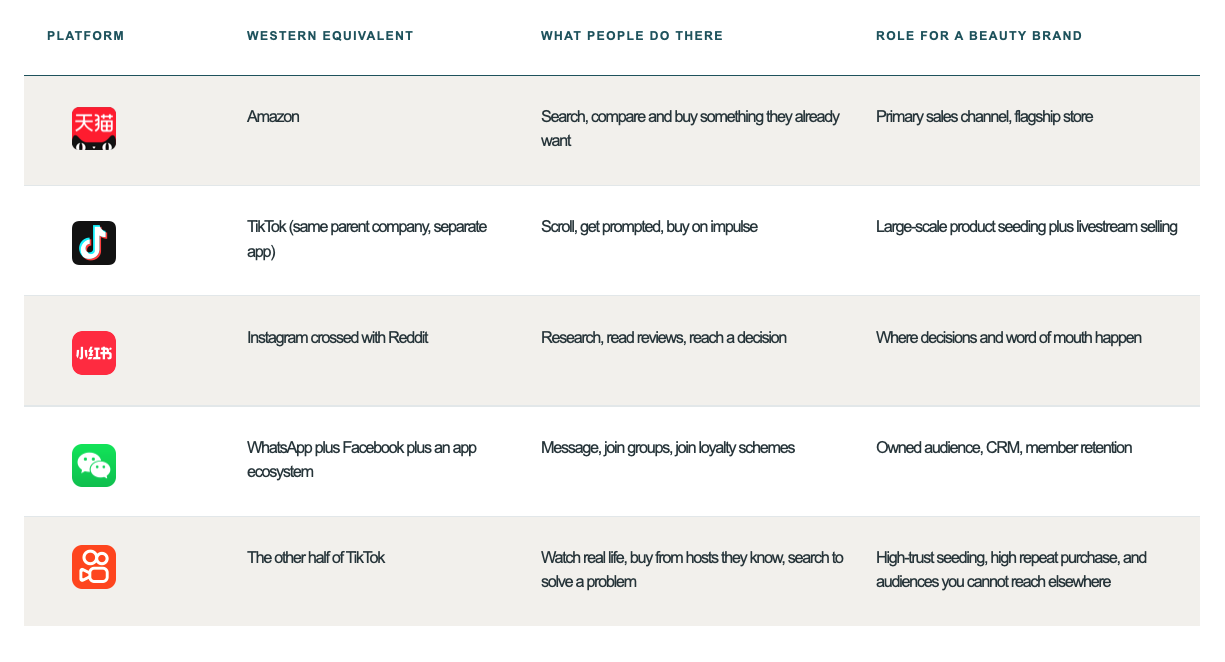
Kuaishou is the second pole of Chinese short video, behind Douyin and clearly ahead of everything else. In the first quarter of 2026 it had 413 million daily and 772 million monthly active users, more than twice RedNote's monthly scale, and it is one of the country's leading livestream commerce platforms.
The four content platforms do not even define beauty the same way. Kuaishou leads on everyday bare-skin looks and practical realism, Douyin on polished faux-bare-face looks with visual contrast, RedNote on sheer, unfiltered originality. Of the four, only Kuaishou ranks "natural makeup" and "bare-skin makeup" as its top looks. The other three all rank "faux bare-face makeup" first. Faux bare-face is a technique. Bare skin is a state. That distinction decides whether your content needs to teach steps at all.
None of this is a choice between platforms. It is a question of which job each one does, and which one you build first.
Why Kuaishou: three structural reasons
1. You cannot reach these people elsewhere, and they spend more
More than 200 million Kuaishou users did not use Douyin in the past month, and more than 500 million did not use RedNote. The value is in quality rather than volume alone: they open Kuaishou 1.8 times as often as the average user, 42.4% sit in the mid-to-high spending tier against 38.1% for Kuaishou overall, and their interest index for beauty is 111. Kuaishou's beauty buyers cluster in the 18 to 39 age range, skew towards higher earners and sit mainly in new-tier cities (tier three and below), and those active only on Kuaishou are younger still and more concentrated in the high-spending tier.
2. Trust is a measurable asset, and in beauty it converts into repeat purchase
Users describe the bond between creators and followers as laotie, roughly "someone you can rely on", and its strength is measurable: 78.9% say Kuaishou creators feel more like friends than celebrities, 90.8% consult creators they follow long term, or familiar voices in the comments, before buying, and 73.0% will pay more for a brand they like.
That converts into retention. 45% of brand advertisers say repeat-purchase rates are higher on Kuaishou than on Douyin, against 25% who say the reverse. Top 100 brands see repeat rates close to twice the platform average, a loyal repeat customer is worth 5.5 times a one-time buyer, and facial skincare is one of the subcategories where repeat purchase exceeds 50%. This matters more in beauty than in most categories, because trust operates at brand level: if a foundation disappoints, shoppers write off the skincare too.
3. The biggest commercial gap is in your price band
Supply and demand by price band in Kuaishou beauty, 2025. The gap is the share of orders minus the share of listings, so a positive figure means demand is running ahead of supply.
| Skincare price band | Share of orders | Share of listings | Gap |
|---|---|---|---|
| Under RMB 50 | 61.7% | 62.6% | -0.9% |
| RMB 50 to 200 | 32.2% | 31.4% | +0.8% |
| RMB 200 to 500 | 5.2% | 4.7% | +0.5% |
| Above RMB 500 | 0.9% | 1.3% | -0.4% |
In colour cosmetics the gap is wider still, at +2.4% in the RMB 50 to 200 band. The low band is oversupplied, the mid band is where demand outruns supply, and RMB 50 to 500, roughly USD 7 to 70 at retail, is where many global beauty brands actually sit in China. Established domestic skincare brands concentrate in RMB 200 to 500, where user numbers grew close to 10% in 2025.
How your consumer is changing
Four shifts are reshaping Chinese beauty demand, and each plays to Kuaishou's strengths.
From the perfect filter to real skin. 49.1% no longer chase flawlessness and 64.3% prefer unfiltered content showing real skin texture. Highly saturated, heavily retouched, studio-lit imagery reads as inauthentic here.
From advanced technique to zero effort. Simple tutorials generate 2.5 times the conversation of advanced technique content. Multi-purpose products and sets are a growth engine rather than a compromise: makeup palette sales more than tripled year on year, tinted lip balm grew close to 80%. If you have something that packages as "three steps, done", that is the fastest route to traction.
From buying beauty to buying a feeling. More than 80% are no longer buying purely to look better, 86.5% see beauty as emotional self-care, and 85.3% enjoy the scent, texture and packaging for their own sake. Three things many European and American brands are already strong at are now sellable value in their own right.
From mass demand to precise segments. 48.3% say growing skincare knowledge has moved them from buying blind to buying deliberately, and 42.1% find specialist products easier to trust. A clearly told ingredient story plus one specific claim beats brand heritage.
Priority audiences: four ways in
Of eight priority beauty audiences mapped in the 2026 Kuaishou beauty industry report, four are growing faster on Kuaishou than across the Chinese internet as a whole, which makes them the highest priority for a brand choosing one point of entry.
| Audience | Size | Profile and angle |
|---|---|---|
| Small-town youth | c. 120 million | 18 to 35, high spending power, new-tier cities. Follow specific product claims, highly responsive to seeding, drawn to domestic brands that feel new |
| Small-town affluent women | c. 46 million | Set the standard for refined living in new-tier cities, personal monthly spend above RMB 20,000 at index 125. Buy for self-reward, weigh packaging and price together, treat formulation and claims as the core consideration |
| Sensitive-skin consumers | c. 18 million | Younger mature women in new-tier cities, personal monthly income above RMB 20,000 at index 146. Ingredient-literate, rational, want precision skincare |
| Couples and gifting | c. 9.5 million | Mainly younger and middle-aged consumers in new-tier cities, using beauty to express feeling. Favour real beauty standards, see value in buying in bulk |
The other four, sizeable but slower growing, are Gen Z (c. 82 million), anti-ageing seekers (c. 51 million), base-makeup perfectionists (c. 33 million) and sun-protection buyers (c. 20 million).
Two of the four are the strongest fit for global brands. Sensitive-skin consumers are ingredient-led and high earning, and want products that are both clinically credible and genuinely gentle, though they currently favour domestic brands they see as better attuned to Chinese sensitive skin, so what you need is locally generated evidence rather than global boilerplate. Couples and gifting carries the highest tolerance for packaging, sets and brand tone, and is the best route to convert existing brand equity into sales.
Brands that have made it work
L'Oréal Paris: the vehicle for beauty seeding is often not beauty content. L'Oréal Paris worked with nine Kuaishou creators, mostly in scripted storytelling, generating more than 22.65 million cumulative views, with micro-drama creators accounting for 60% of orders. The lesson: the effective carrier for beauty seeding here is frequently drama, rural life and everyday-life content rather than beauty content itself, with the product placed naturally in the middle of a story.
Guyu: high-quality seeded audiences on a modest budget. This Chinese skincare brand paid to amplify creator content with brand seeding as the optimisation goal. Cost per newly seeded R3 user (the platform's label for people measurably closer to purchase) came in under RMB 0.5, 21% below the brand's own quarterly average, with engagement 18 times higher than organic reach alone. The lesson: creator content plus paid amplification is far more efficient than either alone.
Kans: turning browsers into buyers. This brand connected discovery (video and livestream) with the store: a livestream that never goes dark, cut into up to 20 short videos a day, plus a dedicated shelf-channel team managing product listings. During Kuaishou's 2025 Year-End Shopping Carnival, product-card GMV across its stores grew 75% period on period and GMV for its hero Hong Man Yao and cleanser lines doubled. The lesson: content creates interest, but buying has to be effortless, and the shelf channel deserves dedicated people.
Five assumptions global brands tend to arrive with
"Kuaishou is lower-tier cities and cheap products." Its beauty buyers skew towards higher earners, and those active only on Kuaishou more so still. The price-band data is more decisive: sub-RMB 50 is oversupplied, RMB 50 to 500 is the gap, and colour cosmetics at RMB 50 to 200 shows the largest gap of any band.
"On Kuaishou you can only move product through discount livestreams." 63.1% of active users search, 91.9% of buyers had searched beforehand, and users who search spend roughly five times as much per head as those who do not.
"Kuaishou content is not professional." Users rate Kuaishou beauty creators on being knowledgeable and explaining things clearly at an index of 124, the highest of any attribute measured.
"Kuaishou is a copy of Douyin." More than 200 million of its users do not use Douyin, the two content mixes are clearly divergent, and even their dominant makeup vocabulary differs. The same asset moved across unchanged usually fails.
"We cannot account for spend on Kuaishou because our store is on Tmall." The platform measures off-platform spillover, covering store visits, transactions and search on Tmall and JD among audiences you reached on Kuaishou.
Conclusion
China's beauty market has passed the trillion-renminbi mark, domestic brands are leading it, and the logic of growth is shifting from traffic to trust. Within that market, Kuaishou offers something the other platforms cannot: an unusually loyal and unusually trusting community, a large audience you cannot reach elsewhere with higher spending power than the platform average, and a commercial gap in exactly the mid-price band where undersupply meets demand.
Compressed into four directions for 2026:
- Invest in genuinely real content. Reviews from ordinary users, 28-day verification formats, side-by-side comparisons.
- Work with the emotion economy. Scene-led, atmospheric content and purchase occasions built around festivals and cultural moments.
- Focus on one segment. Credible specialist content in a vertical, answering a defined community.
- Build long-term IP collaborations. Sustained relationships that compound brand and performance together.
The brands that win here all do three things: show up as they actually are, remove every obstacle between discovery and purchase, and treat content as a core capability rather than an afterthought.
How YASO can help
Kuaishou rewards brands that understand its culture and run short video, livestream, search and store as one coherent operation. That is hard to do from outside China, and harder still without a local team.
YASO helps global beauty, wellness and lifestyle brands enter China and scale, from platform strategy and content production through to livestream and social commerce operations across Kuaishou, RedNote, Douyin and Tmall. If you want to work out whether Kuaishou is the right first step for your brand, we can help you build it properly. Get in touch via goyaso.com.
Sources: 2026 Kuaishou Beauty Industry Marketing Report (Miaozhen Systems and Kuaishou), covering Miaozhen full-web social data January 2025 to March 2026 across Kuaishou, Douyin, RedNote and Bilibili, an online quantitative survey of beauty consumers 2026 (N=1,016), in-depth interviews with beauty industry experts (N=3) and Kuaishou platform data; CTR, 2026 Kuaishou User Insights (June 2026), consumer survey N=2,684 and advertiser survey N=100; 2025 Kuaishou Brand Marketing Guide (Magnetic Engine); market sizing from the China Association of Fragrance, Flavour and Cosmetic Industries, Key Data and Development Trends in China's Cosmetics Industry 2025, the National Bureau of Statistics and Miaozhen brand ad tracking; user numbers from Kuaishou Q1 2026 results.