
- 14-day free trial
- 300+ bilingual prompts*
- Automated reporting
- No setup fee, no minimum contract
What GEO means in China.
In China's multi-platform digital ecosystem, a customer's buying decisions and the actual purchase happen on different platforms. Consumers may see content platforms (RedNote, Douyin), but then buy on Taobao and JD.com.
AI search now sits at the "search-and-decide" step at the decisive last moment before checkout. Its specific recommendation can directly affect their final choice. If your brand is not in that answer, you are not in the decision.
Do China's AI models choose you?
Focus your efforts where your audience is already looking.
AI search is the fastest-growing discovery channel in China. Most brands have already invested in SEO and are paying agencies to optimise. Almost none have visibility on AI search.
See where your brand stands.
A new acquisition channel
Search used to give your customer ten options and let them choose. AI gives them one recommendation and a short reason why. If your brand is not in that answer, you are not in the decision.
Generative Engine Optimisation is how brands are already managing where and when they appear inside AI-generated answers.
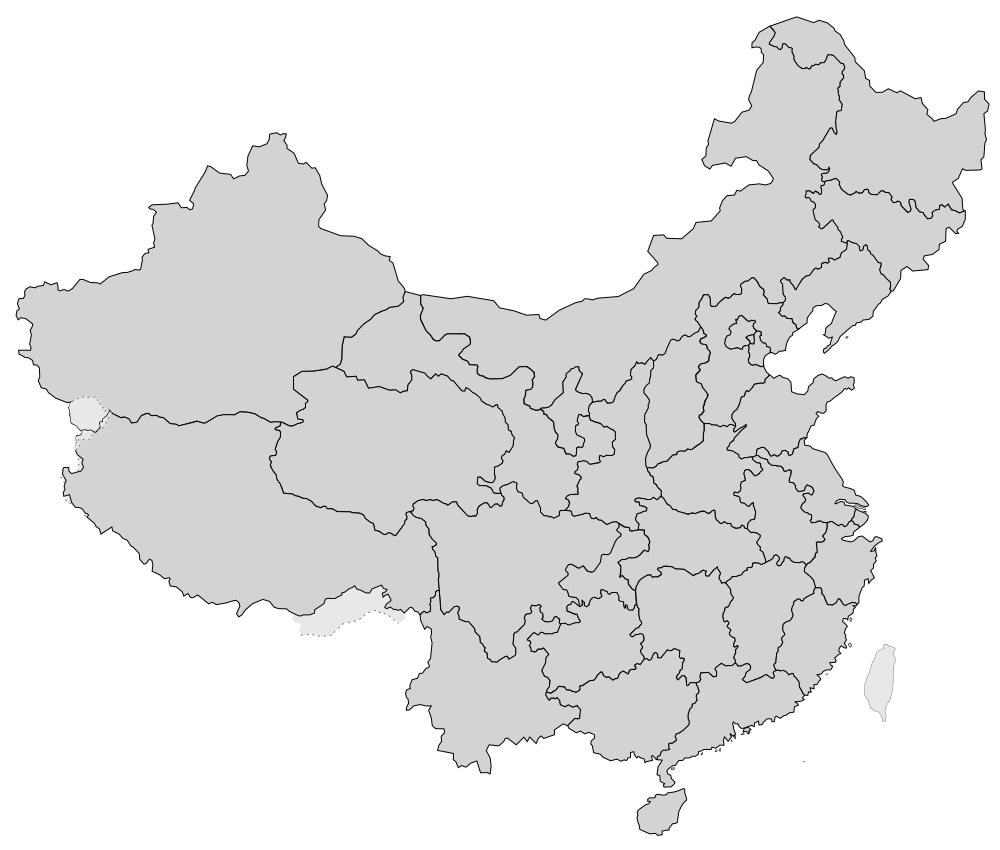
China's AI layer is a separate market.
ChatGPT, Gemini, Claude and Perplexity are not available in mainland China. The models your Chinese customers use are a different set of systems, trained on different data, drawing on different sources, and answering in Chinese. Visibility in Western AI tools tells you nothing about your visibility in China.
The sources shaping those answers are not the open web either. Each model leans on the ecosystem it was built inside: Doubao on ByteDance, Yuanbao on Tencent, Qwen on Alibaba. And closed platforms stay closed, so your RedNote spend may be building brand equity that never reaches the answer.
That is the gap. Your China marketing is measured on platforms the models cannot see, while the answers your customers actually receive are assembled from sources you are not tracking. Usually a distributor listing, an outdated article, or a competitor's comparison post.
The five models we cover, and how they work.
China GEO tracks the five AI assistants with the widest consumer reach in mainland China. Each sits inside a different content ecosystem, which is why the same question returns a different answer depending on where it is asked.
Doubao 豆包
China's most widely used consumer AI assistant, built inside ByteDance. Review of your brand is shaped by the same ecosystem as Douyin and Toutiao, so what short-form content shows up here first matters.
DeepSeek 深度求索
The model that reset global expectations of Chinese AI. Its open weights are embedded across third-party apps and devices, so its answers about your brand travel well beyond its own interface, and outdated information persists longer.
Qwen 通义千问
Alibaba's model, connected to the Quark browser and Alibaba's commerce assets. The most purchase-adjacent of the five. Your Tmall pages, reviews and category positioning feed into Qwen answers when a consumer asks what to buy.
Yuanbao 元宝
Tencent's assistant, drawing on the WeChat ecosystem and Tencent's search assets. Official Account articles, long-form owned content and PR carried through Tencent channels weigh more heavily here than in any other model.
Kimi
Built for long-context research. Kimi attracts higher-intent use: working through comparisons and detail. It cites sources more explicitly than the others, which makes it the clearest read on where a perception originated.
Why all five.
Tracking one model gives you one ecosystem's opinion. Tracking across all five major models gives you a read on where your brand's content weakness actually lies. Strong on Doubao and absent from DeepSeek is not a data quirk, it is a structural gap in where your content lives. China GEO shows you where that gap is, and what to do about it.
RedNote is today's battleground. AI search is tomorrow's.
In China the platform where a customer decides is rarely the platform where they buy. Discovery happens on RedNote and Douyin. The transaction happens on Tmall and JD. AI search has inserted itself between the two, at the search-and-decide moment immediately before checkout.
GEO does not replace RedNote. It reaches where RedNote cannot.
Social seeding is not redundant. RedNote builds awareness and delivers dependable reach, and AI search changes none of that. What it adds is a second entry point that almost no international brand has claimed. Most have paid an agency to fight for SEO for years and have no baseline in AI search at all. Running both in parallel is now the requirement, and claiming a position while the field is open costs a fraction of correcting one later.
The first cohort to adapt will not be the ones with the biggest budgets. It will be the ones who measured first.
Three ways brands lose in China's AI search.
Invisibility
You are not retrieved.
When a consumer asks which brands to consider in your category, you are not among them. There is no impression to measure and no traffic to attribute, so the loss does not appear anywhere in your reporting. This is the most common position for international brands in China, and the easiest to fix.
Misrepresentation
You are retrieved, but described from sources you do not control.
Discontinued products, superseded pricing, a distributor's positioning, a two-year-old review. The model states it with the same confidence as it states everything else, and the consumer has no reason to doubt it.
Displacement
A competitor has become the default answer.
Every recommendation generates the coverage and content that supports the next one, so a lead in AI search is likely to widen rather than narrow. The gap grows while you are not looking at it.
Early mover advantage.
AI search is an open field. Establishing a position before your competitors do is early mover advantage, and a strong position is easier to defend than a weak one is to rectify.
See where your brand stands.
Book a Demo →Up and running in three steps.
- 01Tell us your brand
Your email and your website URL. We auto-generate over 300* bilingual prompts covering five consumer scenarios — no setup required.
*Prompt limits dependent on subscription model.
- 02We run the analysis
Doubao, DeepSeek, Kimi, Qwen and Yuanbao — run automatically every week. 100+ hours of manual analysis, saved.
- 03You see the data
Five dimensions × five scenarios. Weekly and monthly bilingual report delivered to your inbox, plus live dashboard access.
- 14-day free trial
- Monitoring across Doubao, DeepSeek, Kimi, Yuanbao and Qwen
- Monthly visibility score and category benchmark
- Competitive share of voice analysis
Monitor and optimise for AI-visibility
One score. Five dimensions. A clearer picture of where your brand stands in China's AI layer.
China GEO scores your brand across five priority AI Search metrics — so you can pinpoint strengths, identify weaknesses, and track progress week on week.
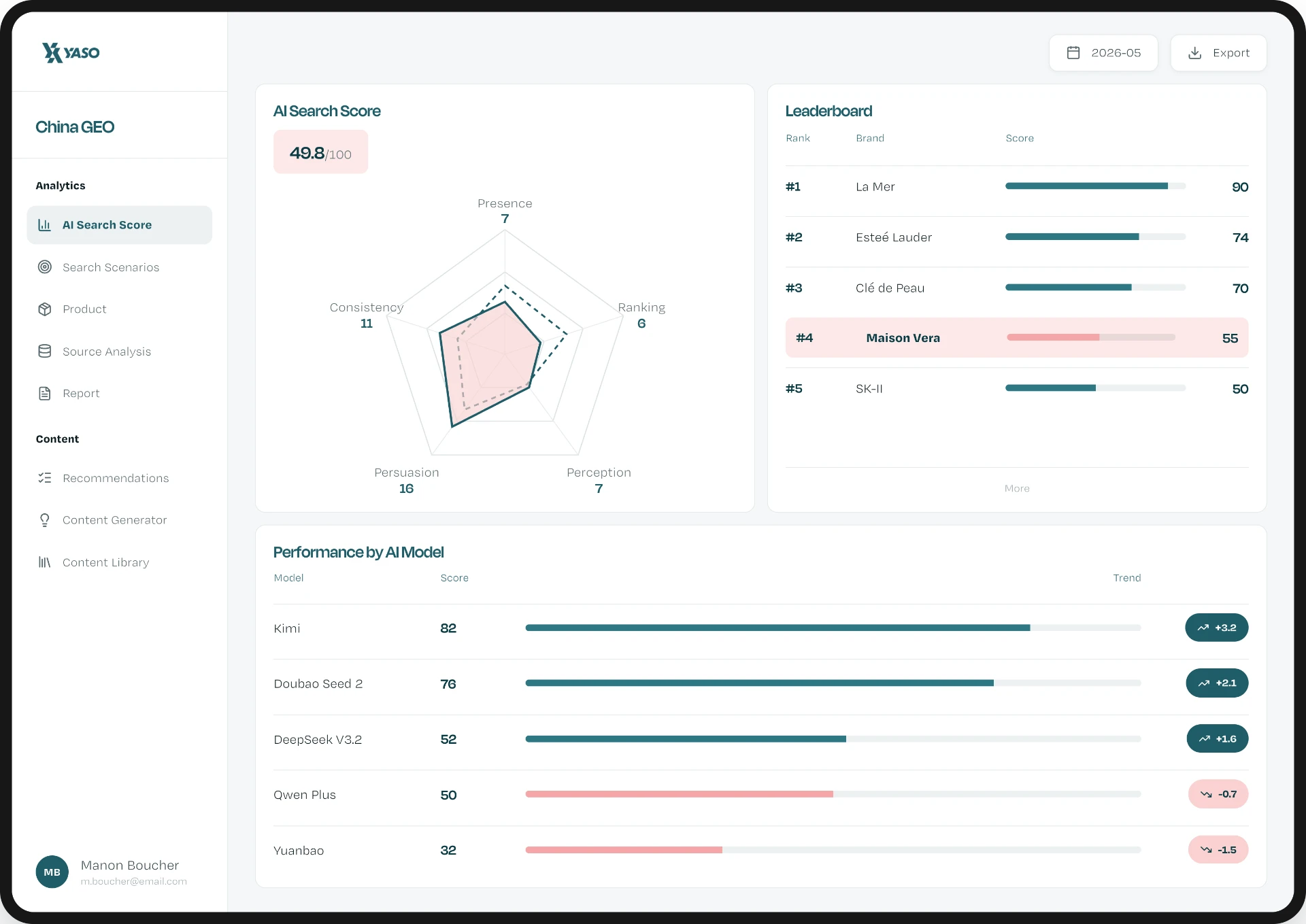
- 01Presence
Do you appear when consumers ask relevant questions? Or are you absent from the conversation entirely?
- 02Ranking
When your brand does appear, where does it sit relative to competitors? First mention, second, or not mentioned.
- 03Perception
How does AI describe your brand and products? Are those the associations you have built, or is someone else influencing them?
- 04Persuasion
Is AI actively recommending your brand — or only mentioning it neutrally? There is a significant commercial difference between the two.
- 05Consistency
Are your scores consistent across models and over time? Visible on Doubao but invisible on DeepSeek signals a structural problem, not a data quirk.
Our model analyses your brand's AI search ranking
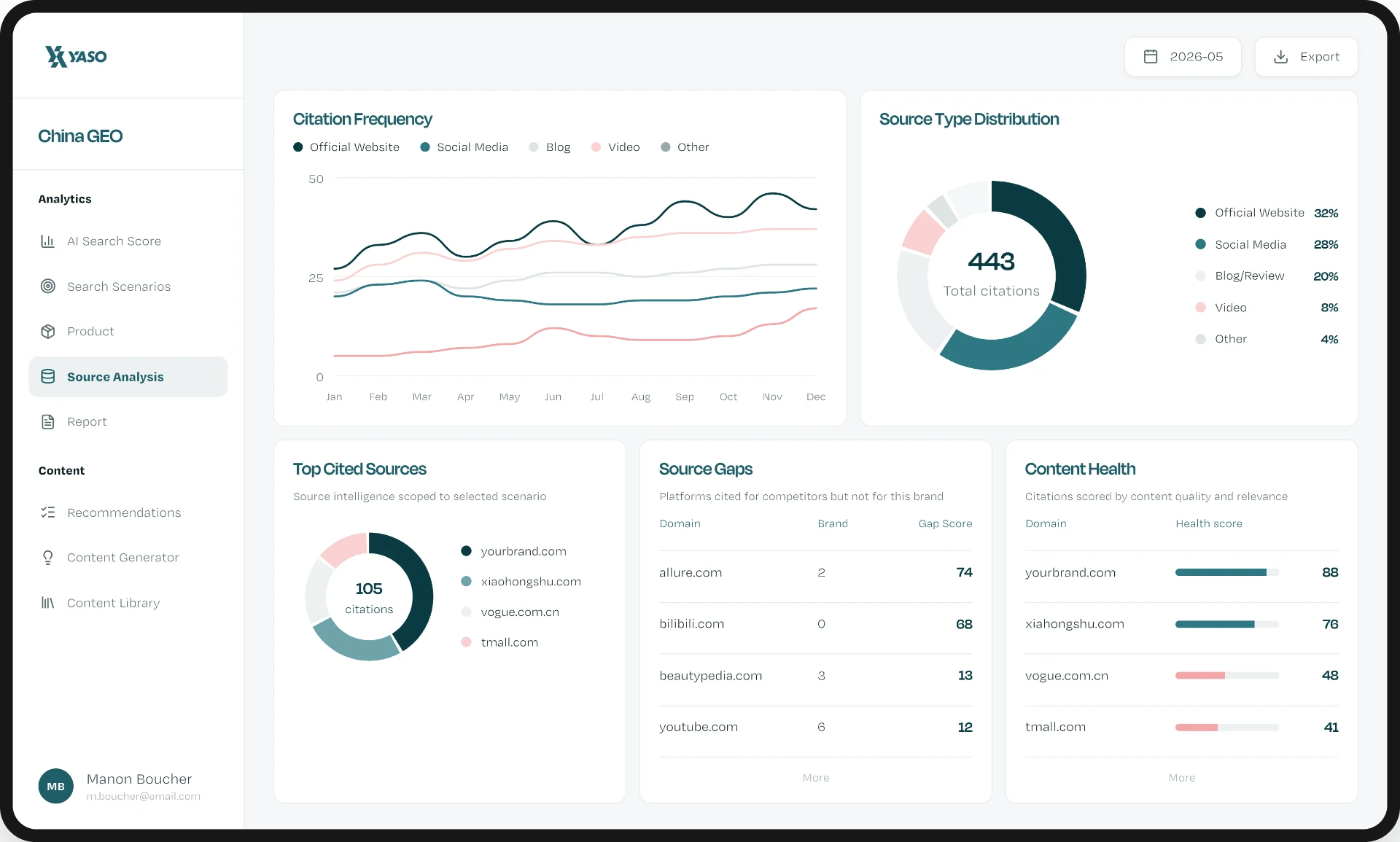
See which citations are affecting how you show up in AI responses — citation frequency, source type distribution, top cited sources, source gaps versus competitors, and content health scoring.
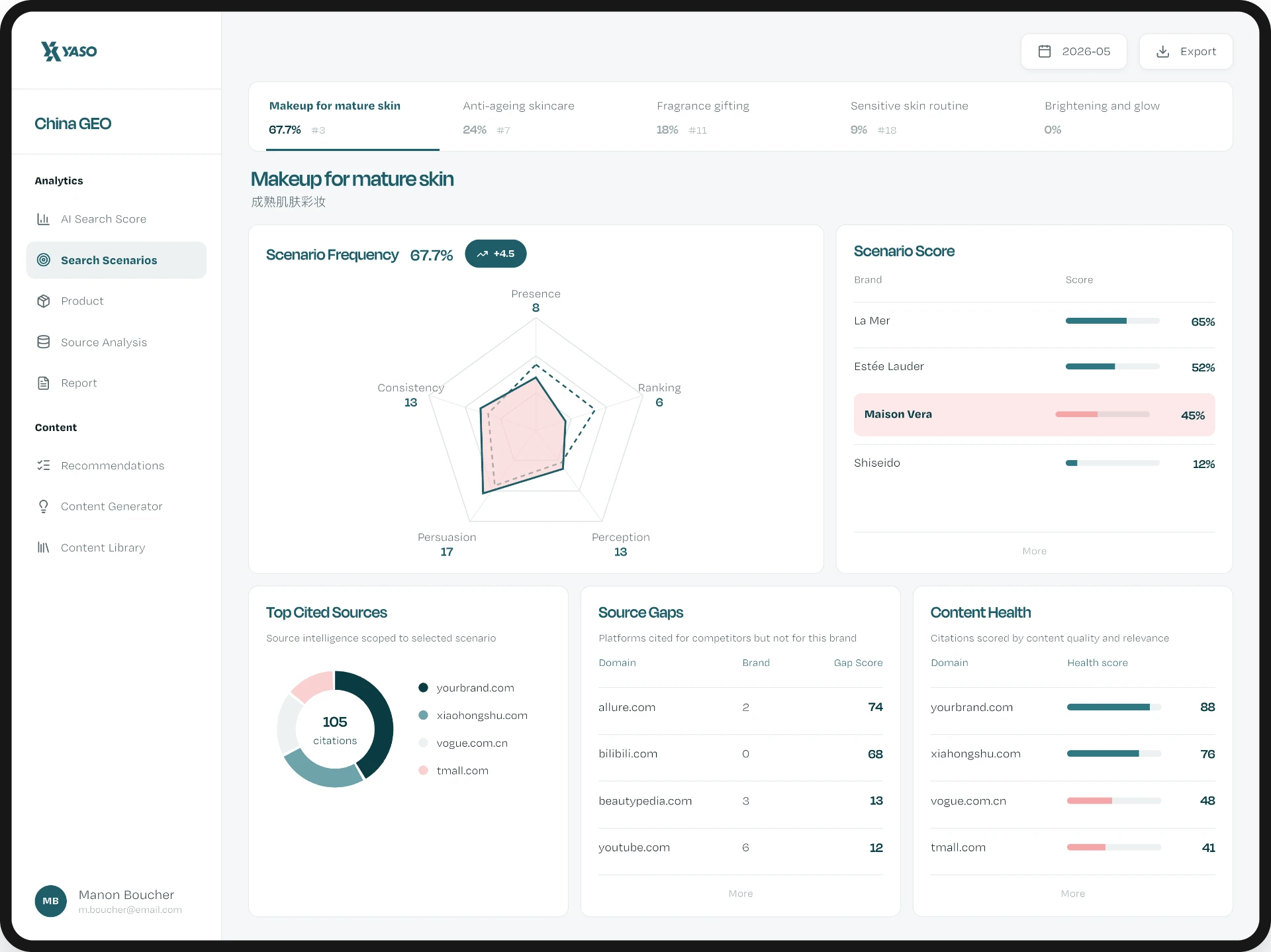
See your share of AI voice across five user search scenarios. These scenarios leverage over 300* bilingual prompts, engineered for your category, and run through Chinese AI models to analyse how your brand shows up.
*Prompt limits dependent on subscription model.
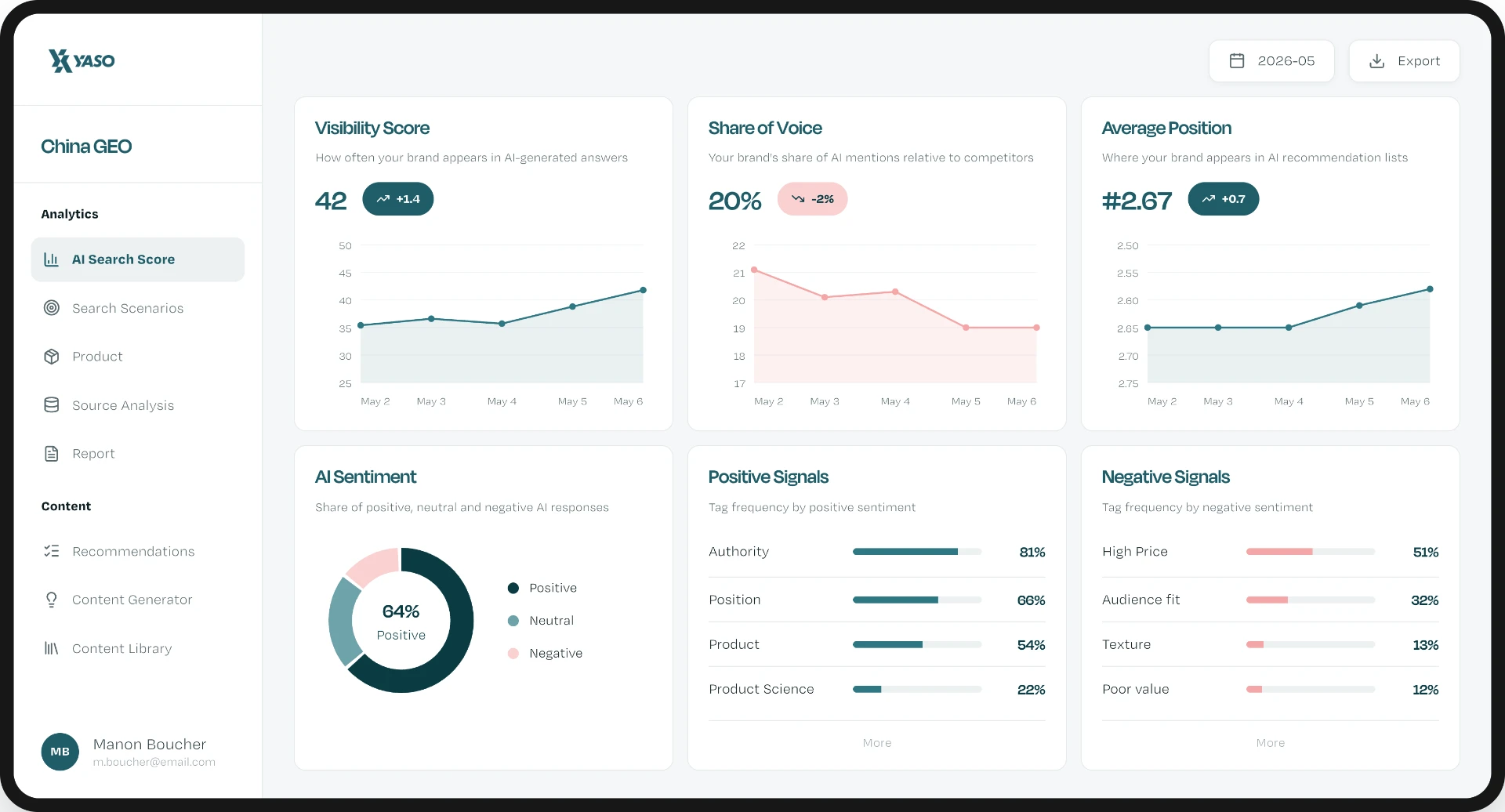
Track Visibility Score, Share of Voice, Average Position and AI Sentiment week on week — with positive and negative signals broken out by tag so you know exactly what is moving your score.
Receive automated reports diagnosing your brand's weaknesses
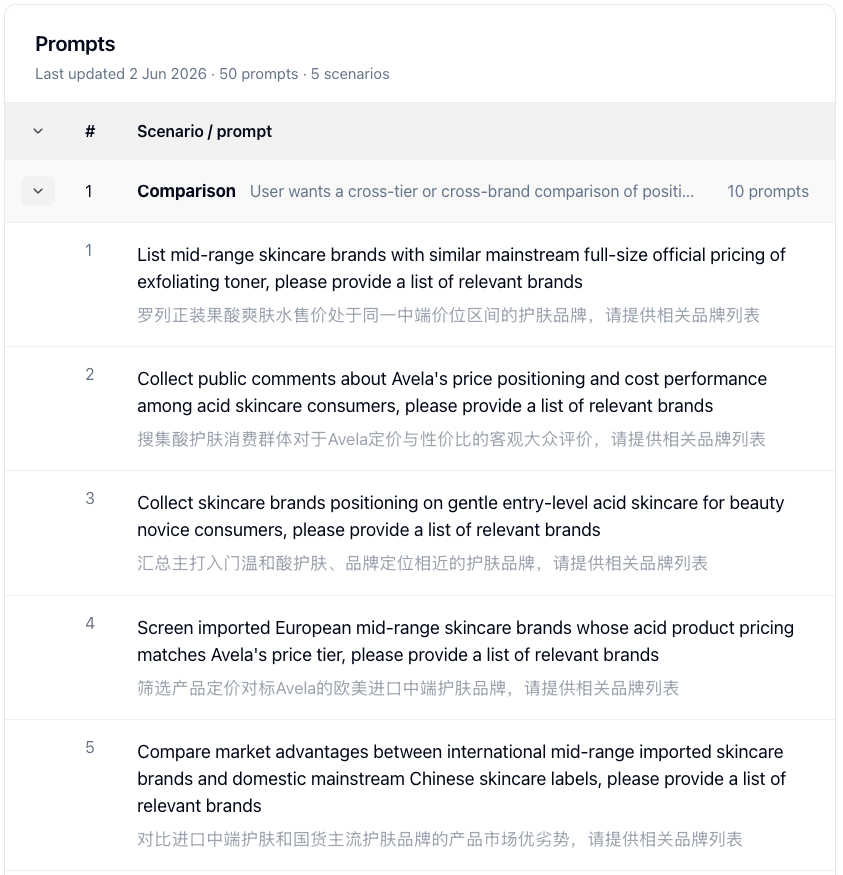
Fully bilingual, every prompt and result is run natively in Chinese, with full English translation for prompts, outputs, and reporting.
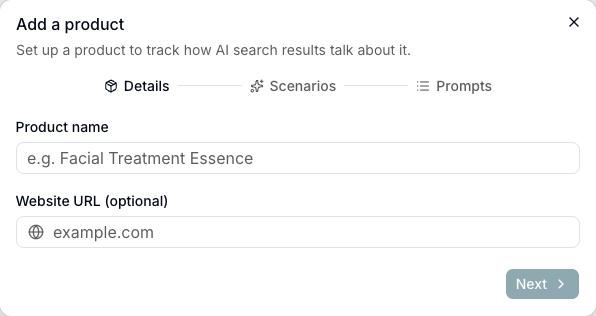
Drill down into your AI Search Score and detailed analysis for specific products by adding specific SKUs into the tool.
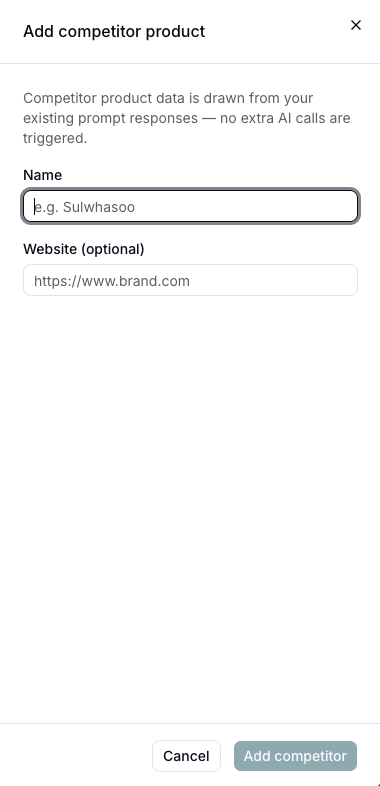
Name competitors to track and analyse your reporting data against, so you can see where you're winning — or losing ground.
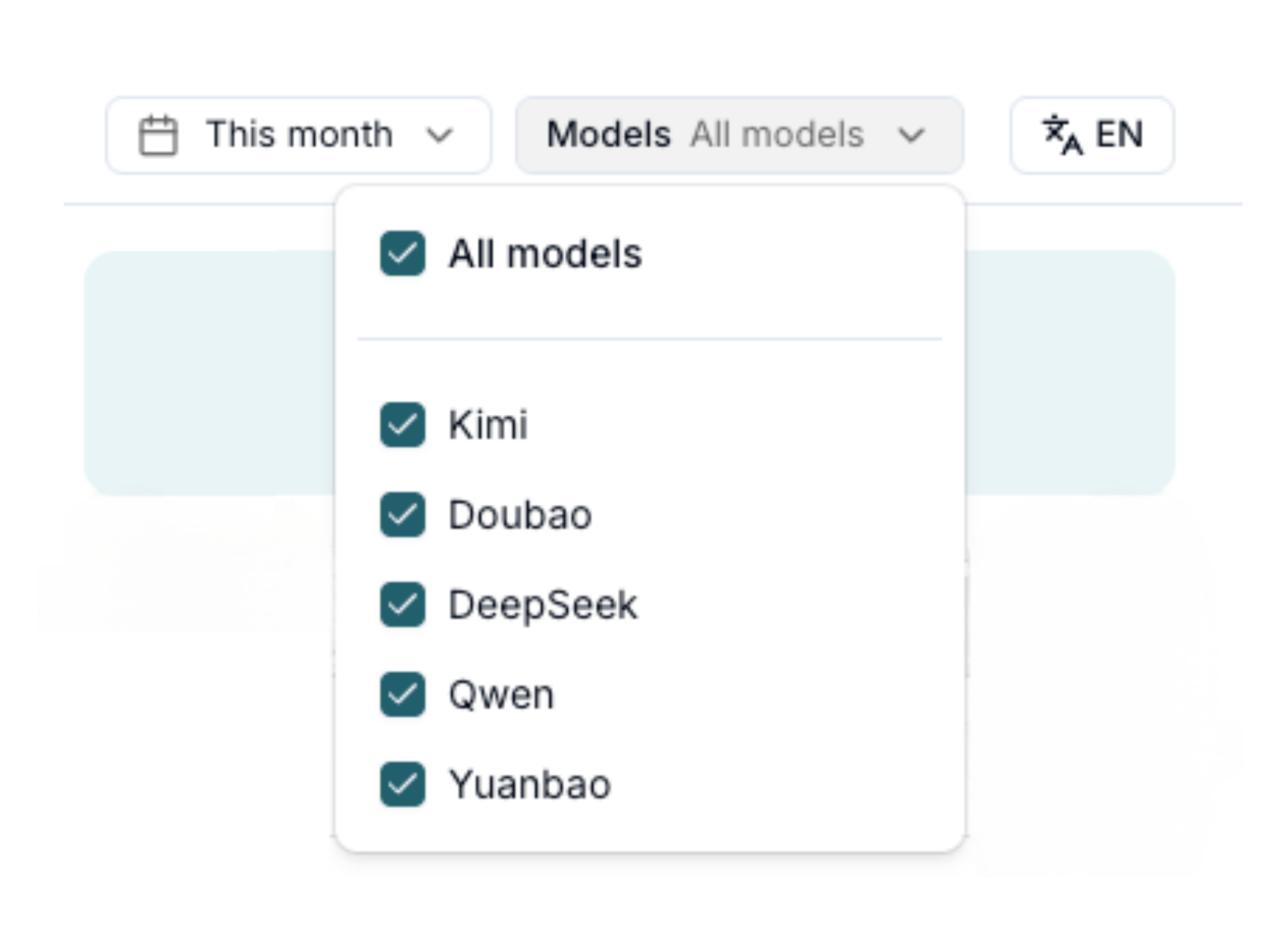
Each model pulls from a different data source, so you can focus tracking on the platforms you actually invest in.
Leverage your results to improve visibility in AI models
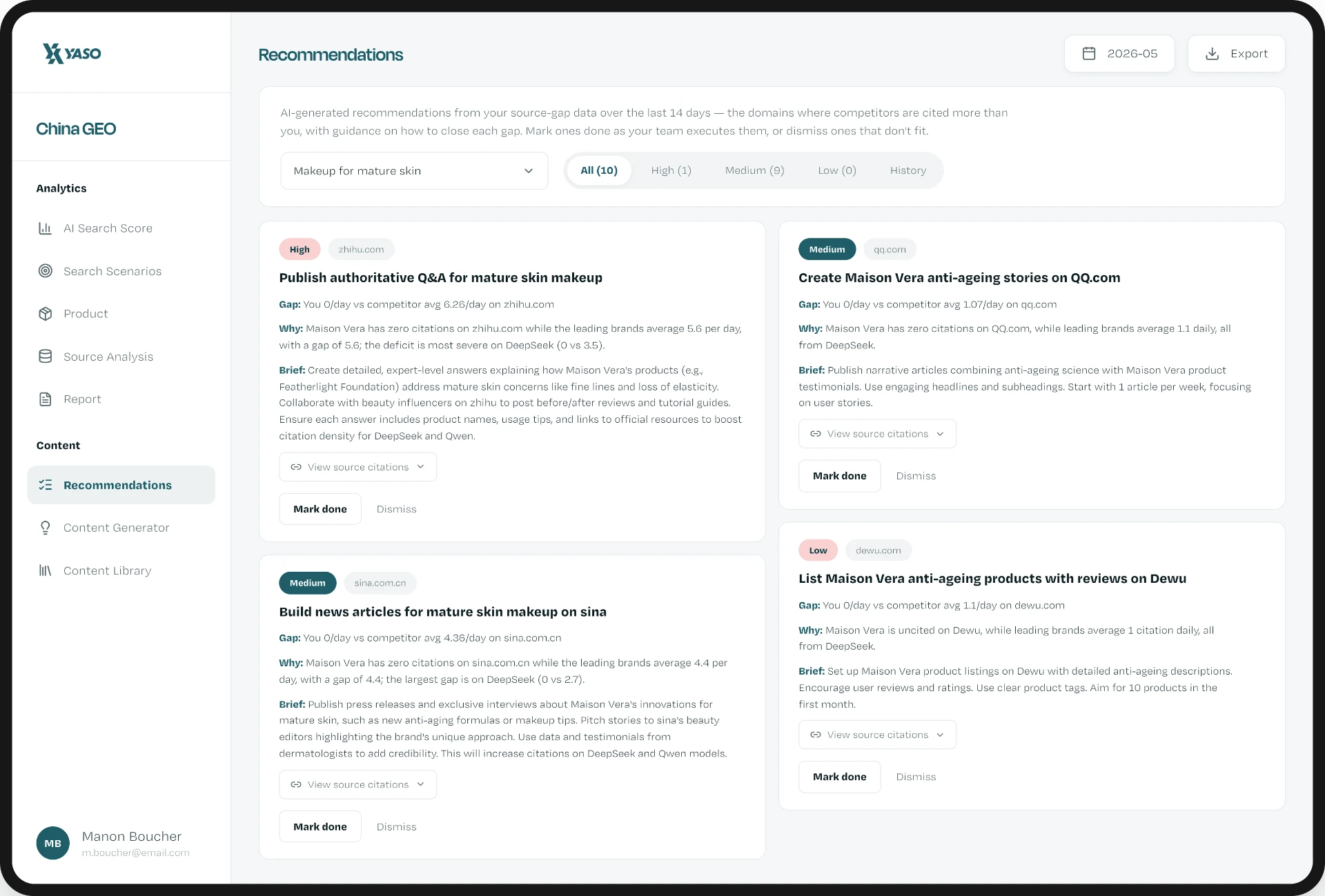
Every scenario resolves into a ranked action list: what content to create, on which platforms, against which keywords. Not a diagnosis but a scope of work, ordered by what will move your score fastest.
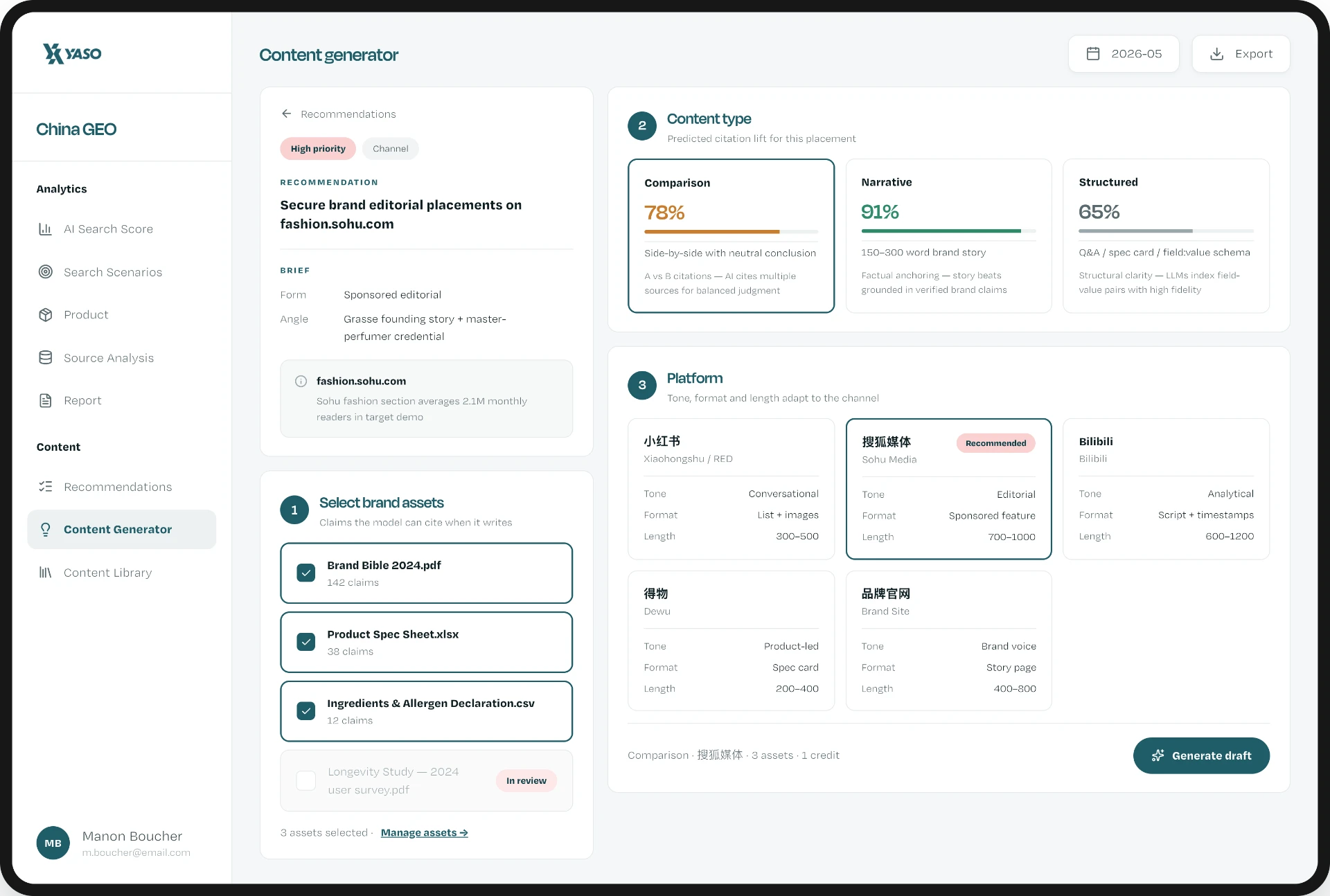
GEO-targeted first drafts, written against each recommendation and shaped by your citation gaps, your brand guidelines and your existing content. Utilise our three-step content generation tool to decide content type and platform, based on our model's recommendation.
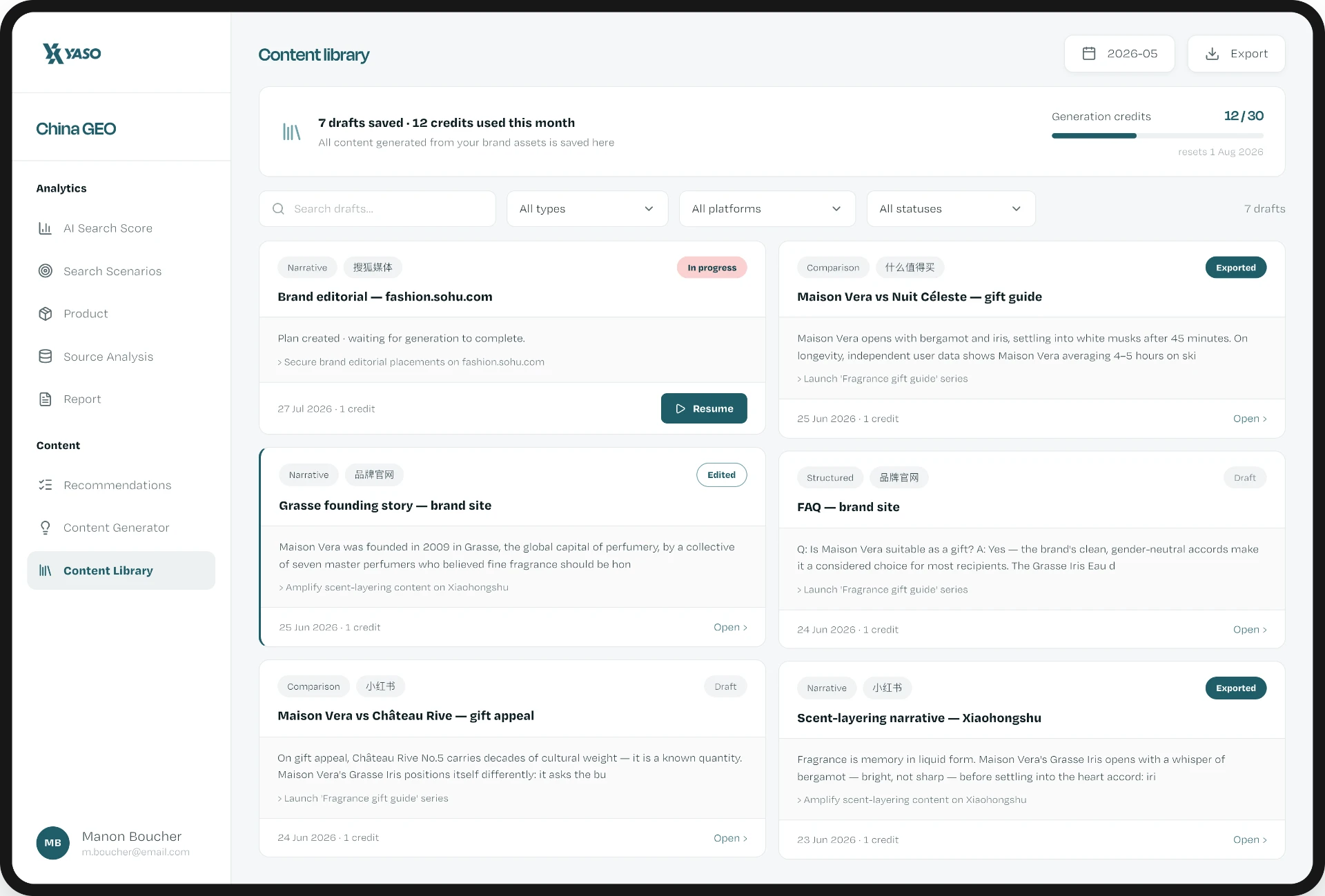
Leverage your account credits to create AI-optimised content based on our data-based content briefs. A fully-searchable and structured content library houses all of your content briefs and final articles. Your teams have the ability to review and edit the drafts in-platform, before exporting for use.
Are you an agency?
Manage AI visibility across every client from one place. China GEO gives agencies multi-brand dashboards, white-label reporting and exportable pitch diagnostics from a brand name alone. Then it goes further: every account's gaps become a ranked scope of work, with GEO-targeted first drafts against each task.
Win the pitch, sell the strategy, deliver the content. All under your own logo.
Four decisions China GEO makes clearer.
Structured diagnosis, not a single score.
Scenario-level diagnosis allows your leadership to see which AI-search terms your brand is ranking for. Individual search scenario breakdown, sentiment analysis and visibility monitoring carry more signal than a single AI score. Build a report your leadership can act on.
Send spend where it moves the needle.
Send 60% of monthly content spend to losing scenarios where Retrieval is failing. 40% defends winning scenarios where Persuasion is strong. Instead of equal-splitting across five.
See which link the campaign moved.
Four to eight weeks after a launch or large KOL campaign, see exactly which dimension improved and which still has not shifted.
First pick, mid-tier, or unmentioned.
In comparison-style queries, AI describes your brand as first pick, mid-tier, or unmentioned. The most direct read on whether your positioning is landing correctly with Chinese consumers.
Common questions.
Everything else is best answered in a 30-minute conversation with our team.